
Choosing among quenching oils requires more than comparing viscosity, colour, or price: the decisive evidence is the cooling curve at your actual bath temperature and agitation rate. By the end, you will be able to match a Meta Quench grade to the steel, process, and distortion risk, then verify the choice through a controlled acceptance test.
Key takeaways
- Ask for cooling-curve data and the technical data sheet for each Meta Quench grade.
- Match oil severity to steel hardenability, section thickness, geometry and distortion risk.
- Control bath temperature, transfer time, agitation and withdrawal timing on every load.
- Specify packaging, batch documents, delivery conditions and HP-authorised supply before ordering.
Compare Meta Quench grades by cooling data, not product labels
A credible Meta Quench series comparison starts with cooling-curve evidence, not the product number or the phrase “quench oil.” A grade labelled accelerated, conventional, high-temperature, or low-distortion has to be supported by its technical-data-sheet values and stated application.
| Comparison field | Candidate grade A | Candidate grade B | Candidate grade C |
|---|---|---|---|
| Maximum cooling rate and temperature | Record test values | Record test values | Record test values |
| Cooling time through critical ranges | Record each range | Record each range | Record each range |
| Viscosity at 40 °C | Record value | Record value | Record value |
| Flash point and operating temperature | Record both | Record both | Record both |
| Intended steel, workpiece, and process | Record scope | Record scope | Record scope |
| Test method and sample condition | ASTM D6200 or ISO 9950; new or used | Record details | Record details |
Do not rank grades from catalogue numbers alone. A cooling curve measured at 60 °C does not establish performance in a bath operating at 100–120 °C, and viscosity at 40 °C cannot be compared with viscosity at 100 °C.
A sound quenching oil comparison uses the same probe, oil volume, bath temperature, agitation, and sample-conditioning procedure for every candidate and the incumbent oil.
Before accepting a ranking, check:
- Whether each result came from fresh, filtered, in-service, or thermally stressed oil.
- Whether oxidation products, sludge, metal fines, scale, water, or additive depletion affected a used sample.
- Whether the reported method, temperature, agitation, and cooling-rate units match across the grades.
Only matched data can show which Meta Quench grade cools faster, cools more uniformly, or suits the process.
Match the grade to steel, workpiece geometry, and quenching process
Carbon steel does not automatically call for an accelerated oil. Match the Meta Quench Series grade to hardenability, section thickness, geometry, and the required cooling curve; a viscosity value alone cannot make that decision.
| Application or process | Appropriate Meta Quench grade | Selection logic |
|---|---|---|
| Carbon steel | Conventional grade for smaller sections; accelerated grade for large sections or low-hardenability steel | Accelerated cooling can improve core hardness but raises distortion and cracking risk. |
| Alloy steel | Conventional or martempering grade | Alloying usually improves hardenability, so excessive severity can create unnecessary stresses. |
| Tool steel | Low-distortion, controlled-cooling grade named for the steel family | Protect dimensional accuracy and cracking resistance rather than chasing the fastest cooling. |
| Bearings | Controlled conventional or martempering grade | Bearing rings and rolling elements need uniform hardness with minimal ovality and size change. |
| Gears | Accelerated grade when the specified case or core hardness requires it | Gear teeth benefit from adequate severity, but excessive cooling can distort tooth geometry. |
| Shafts and springs | Conventional grade for moderate sections; accelerated grade for large diameters or difficult hardening | Compare hardness through the section against runout and straightness limits. |
| Martempering | Grade whose data sheet specifies martempering use and the required bath-temperature range | The oil must hold the part near the equalising temperature before final cooling. |
Use a bright grade when reduced staining matters; use a darker accelerated grade when the steel and geometry demand greater severity. A sound quenching oil comparison verifies the chosen grade against the incumbent using identical bath temperature, agitation, oil volume, and probe conditions.
Use cooling curves and bath temperature to control hardness and distortion
A faster cooling curve does not automatically produce better parts. It can raise hardness while increasing distortion or cracking, so judge the curve against the steel, section thickness, and acceptable dimensional change.
ASTM D6200 and ISO 9950 results are useful only when the report identifies the probe, bath temperature, agitation, oil volume, and oil condition.
| Standard | What to check | Why it matters |
|---|---|---|
| ASTM D6200 | Maximum cooling rate, temperature at that rate, and cooling time through critical ranges | Shows how the oil removes heat during actual quenching stages |
| ISO 9950 | Cooling curve measured with the specified probe and test conditions | Supports comparison only when the method and conditions match |
Do not compare an ASTM D6200 curve at 60 °C with production oil running at 100–120 °C. Use data from the actual bath temperature, or request curves at several temperatures; viscosity and cooling severity change as the bath heats.
Agitation changes the boundary layer around the workpiece. Stronger circulation usually increases heat removal, while a stagnant tank can create soft areas even with acceptable laboratory data.
Check the bath before accepting a quenching oil comparison:
- Water contamination, which can cause violent vapour formation and staining
- Viscosity change, which signals oxidation or contamination
- Sludge and additive depletion, which can flatten the intended cooling response
Run the candidate and incumbent oil with the same probe, oil volume, temperature, agitation, and conditioning procedure. Otherwise, catalogue numbers can rank the test method rather than the oil.
Run the quench consistently from furnace transfer to oil withdrawal
A repeatable quench starts before the furnace door opens. Record the bath temperature, oil level, agitation setting, load mass, and furnace exit time for every batch.
1. Prepare the tank by removing sludge, scale, water, and residue from the previous grade. Confirm the tank is dry, filled to the marked operating level, and fitted with working circulation and temperature instruments.
2. Start circulation before loading the workpiece. Check the oil temperature at more than one tank location; do not begin if readings differ beyond your written process limit.
3. Use a stopwatch for transfer time, starting when the load leaves the furnace and ending at complete immersion. Set a maximum transfer time in the recipe; delay creates a softer surface and uneven hardness.
4. Load baskets without crowding parts or blocking oil flow. Keep gears, shafts, springs, and other shapes separated, then start the specified agitation before immersion and maintain it through the cooling interval.
5. Check bath temperature immediately before immersion and after withdrawal. Withdraw the load at the validated temperature or time, drain oil over the tank, and prevent hot parts from contacting air before the required cooling stage.
6. Maintain the bath by filtering contamination, checking water content, viscosity, acid number, and sludge at scheduled intervals, and topping up only with the approved grade. For industrial quenching oil in hubballi, retain the batch number, certificate of analysis, and cooling-curve report with each tank record.
Choose oil against water, brine, polymer, or gas—and specify the supply correctly
Water and brine remove heat faster than oil, but that severity raises cracking, distortion, and soft-spot risk in gears, shafts, and thin sections. Choose quenching oil when you need a slower, more uniform cooling rate, especially for alloy steel, tool steel, bearings, springs, or complex shapes.
| Option | Main advantage | Choose it when |
|---|---|---|
| Water | Very severe cooling | Low-alloy sections tolerate high distortion and cracking risk |
| Brine | Faster, more uniform water cooling | Vapour-film problems must be reduced and distortion is acceptable |
| Polymer quenchant | Adjustable severity with lower fire risk | You can control concentration, temperature, and contamination |
| Gas | Clean, low-distortion cooling | The furnace and steel grade support pressure-gas hardening |
| Quenching oil | Balanced cooling and hardening | You need repeatable hardness with less cracking than water-based media |
Before accepting a Meta Quench shipment, give quenching oil distributors hp a written specification. State the exact grade, open tank or sealed furnace, agitation method, operating temperature, and whether the bath serves conventional, accelerated, or martempering work. Clarify whether HP means HPCL-authorised supply or a search abbreviation; authorisation alone does not prove technical suitability.
Request:
- Batch number and certificate of analysis
- Viscosity at the stated test temperature, flash point, water content, and acid number
- Cooling-curve report identifying ASTM D6200 or ISO 9950 conditions
- Storage history and confirmation that the sample is new, filtered, or thermally stressed
- A comparison sample for your incumbent oil using identical bath temperature, probe, volume, agitation, and conditioning
For industrial quenching oil in hubballi, ask Bangalore Industrial Oils to identify those documents before dispatch, not after the drums arrive.
Related product
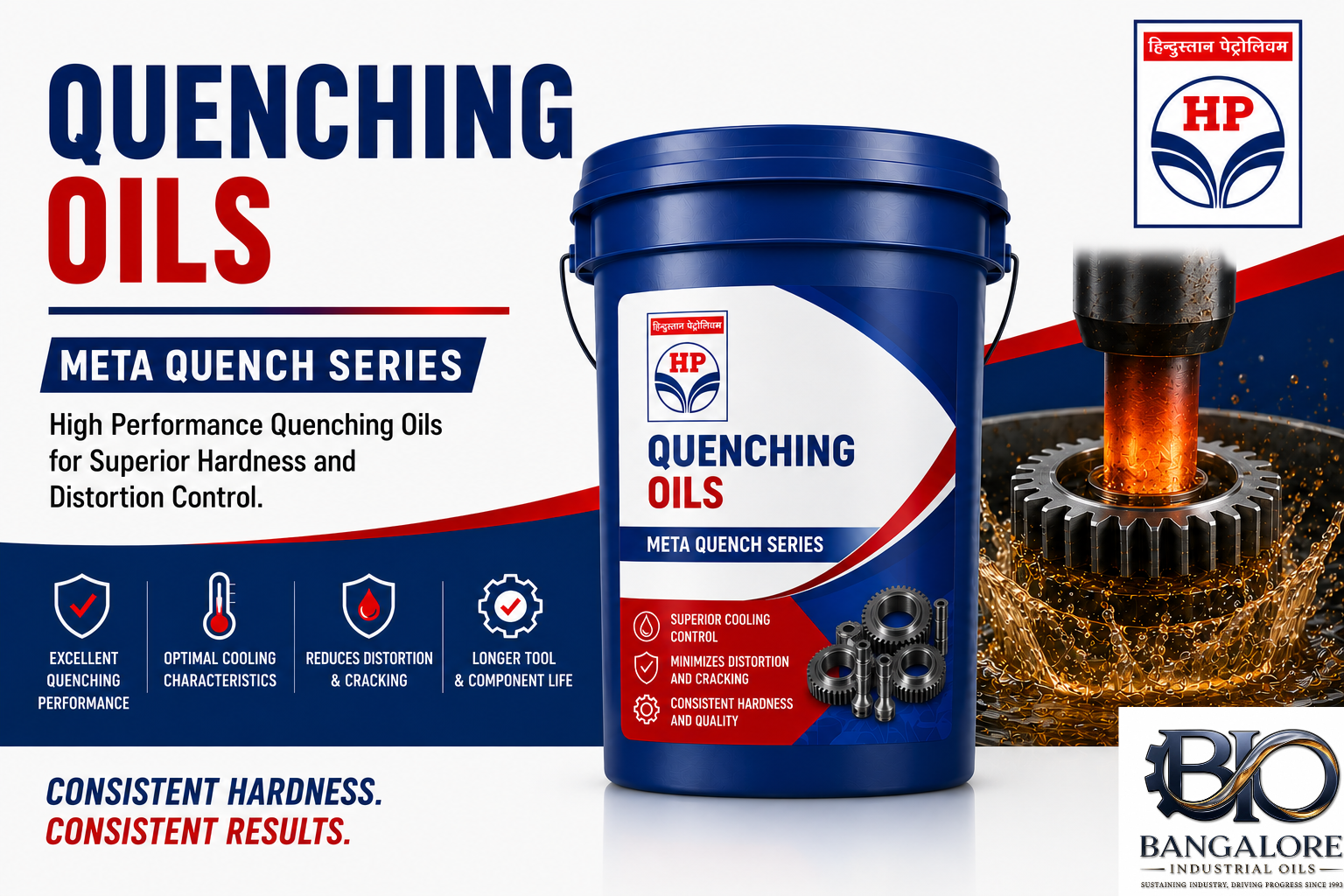 | QUENCHING OILS Looking for reliable Quenching Oils dealers in Karnataka? Bangalore Industrial Oils is a trusted supplier offering high-quality quenching oils... View product → |
Frequently asked questions
How should you compare Meta Quench grades?
Compare cooling-curve data, stated operating temperature, application guidance and technical-data-sheet values rather than relying on grade names such as accelerated or conventional.
How do steel type and workpiece geometry affect quenching-oil selection?
Match the oil to the steel’s hardenability and the part’s section thickness, shape, holes, sharp corners and distortion risk. A severe oil is not automatically the correct choice.
Which process controls affect hardness and distortion?
Control bath temperature, agitation, furnace-to-tank transfer time, load spacing, oil cleanliness and the time the workpiece remains in the bath.
How does quenching oil compare with water, brine, polymer and gas?
Water and brine remove heat aggressively but increase cracking and distortion risk; polymer concentration changes cooling severity; gas is cleaner and gentler but needs suitable equipment and steel. Compare the process result, not only the fluid price.