
A heated steel part does not cool at one constant rate after it enters an oil tank: vapour-film, boiling and convection stages determine the final hardness, distortion and cracking risk. By the end, you will know how to compare a Meta Quench grade, specify the tank and controls it needs, and verify that the oil still performs within the supplier’s limits.
Key takeaways
- Vapour, boiling and convection stages control how quickly quench oil removes heat.
- Match oil viscosity and cooling speed to the steel part and quench process.
- Control bath temperature, circulation, agitation and fill volume before production runs.
- Request the exact Meta Quench grade, technical data sheet and batch documents.
How quench oil removes heat from hot steel
An industrial quenching oil removes heat in three stages. First, the hot steel enters the bath and creates a vapour blanket that temporarily insulates its surface. Once that film collapses, nucleate boiling begins and removes heat rapidly. Below the oil’s boiling range, slower convection carries heat from the part into the surrounding oil.
The cooling curve matters more than viscosity or flash point alone because it shows cooling speed at each temperature. Pay particular attention to the steel’s critical transformation range, where austenite changes into martensite or bainite.
A high peak cooling rate can harden thick or difficult sections, but it also increases residual stress, distortion, cracking and dimensional variation.
Agitation changes the effective severity of the quench. It breaks up the vapour blanket and moves cooler oil around the load, but excessive or uneven flow can produce different hardness around holes, corners, thin sections and tightly packed baskets.
Flash point is a safety and handling property, not a direct measure of quench severity. Two oils with similar kinematic viscosity can have different additives, vapour-film stability and boiling behaviour, so their cooling curves can differ sharply.
A buyer searching for general purpose machinery oil wholesalers HP should compare those curves under stated test conditions, not select an industrial quenching oil by viscosity, flash point or the word “general-purpose” alone.
Which parts and quench processes suit each oil type
A conventional industrial quenching oil suits carburised gears, bearings, dies and fasteners when the steel already has enough hardenability and dimensional stability matters. Shafts and through-hardened components may need accelerated oil if their centres remain too soft after conventional cooling.
| Oil type | Cooling behaviour | Suitable use | Main risk |
|---|---|---|---|
| Conventional | Controlled cooling through transformation | Gears, bearings, dies, fasteners and carburised parts needing lower distortion | Insufficient core hardness in thick or low-hardenability steel |
| Accelerated or fast | Higher cooling rate | Thick shafts and through-hardened components that struggle to reach target hardness | More cracking, residual stress and distortion |
| Martempering | Equalises temperature before final transformation | Parts designed for reduced thermal gradients and controlled distortion | Fails if the furnace, transfer time and hold stage are not validated |
Selection begins with steel grade, section thickness, hardenability, required hardness profile and allowable distortion—not with a brand name or “general-purpose oil.” A martempering process needs its own temperature, timing and agitation controls; it is not a faster version of ordinary quenching.
Meta Quench grades are not interchangeable. Additive-treated, fast, conventional and hot-quenching oils with similar viscosity can produce different vapour-film and boiling behaviour. Match the grade to furnace temperature, transfer time, bath temperature, agitation and required martensitic or bainitic structure.
Ask a quenching oil supplier serving the Meta Quench Series in Mangaluru for the exact grade, rather than treating every industrial quenching oil as equivalent.
How to run the bath and size the quench system
Before ordering oil, confirm the steel grade, part geometry, required hardness and tempering specification. Then heat the bath only within the exact product data-sheet range: warmer oil lowers viscosity and improves circulation, but reduces the temperature difference, accelerates oxidation and can change hardness.
Circulate before loading, immerse the part fully, maintain even agitation, and hold it until the part reaches bath temperature or the validated process endpoint. Transfer hardened steel promptly for tempering.
- Size tank volume to absorb the batch’s heat load without excessive temperature rise. An undersized bath loses cooling consistency across the load.
- Specify pump capacity and agitation speed so oil moves uniformly around every part, not so fast that turbulent flow creates hot spots or uneven hardness.
- Put filtration flow, filter rating, tank geometry, basket loading and heat-exchanger capacity into the quotation. A search phrase such as general purpose machinery oil wholesalers HP does not define these requirements.
- Ask a quenching oil supplier to assess the actual service and batch size, rather than treating every tank as equivalent.
| Service type | Equipment question | Why it changes the order |
|---|---|---|
| Batch | What is the load mass, basket size and cycle time? | Tank volume and heat removal must suit each charge. |
| Continuous | What is the line speed and part spacing? | Flow, residence time and heat-exchanger duty govern consistency. |
| Sealed-quench | What atmosphere, transfer time and cover system apply? | Furnace-to-bath handling affects oxidation and cooling. |
| Open-tank | How will vapour, fire protection and contamination be controlled? | Tank layout, filtration and safety systems become part of the design. |
What to request when buying a Meta Quench grade in Mangaluru
Before comparing quotations, demand documents for the exact HP product designation, not merely the Meta Quench family name. Request:
- The current technical data sheet and safety data sheet
- Batch number and certificate of analysis or certificate of conformity
- Kinematic viscosity at 40°C, flash point and fire point
- Recommended bath-temperature range, maximum working temperature and storage life
- Compatibility restrictions and confirmation that the grade is intended for cold, warm or accelerated quenching
- Cooling-curve results, including test method, specimen, bath temperature, agitation and the applicable ASTM D6200 or ISO 9950 information
| Quench designation | What to verify | Selection warning |
|---|---|---|
| Cold quenching | Intended bath temperature and cooling curve | Do not assume it suits every steel section |
| Warm quenching | Operating range and maximum working temperature | A warmer bath lowers viscosity but changes cooling severity |
| Accelerated quenching | Cooling rate through the steel’s critical range | The highest rate can increase distortion, stress and cracking |
Compare the curve with your steel grade, section thickness, required hardness profile and established plant process. Do not select the fastest curve because peak cooling rate alone does not predict a successful part.
The phrases general purpose machinery oil wholesalers HP Meta Quench in Mangaluru, meta quench series in mangaluru and general purpose machinery oil wholesalers HP describe a sourcing search, not a performance class or accepted substitute.
Bangalore Industrial Oils can provide a practical document check: ask for the exact grade records and batch documents, then compare them with your validated process.
Related product
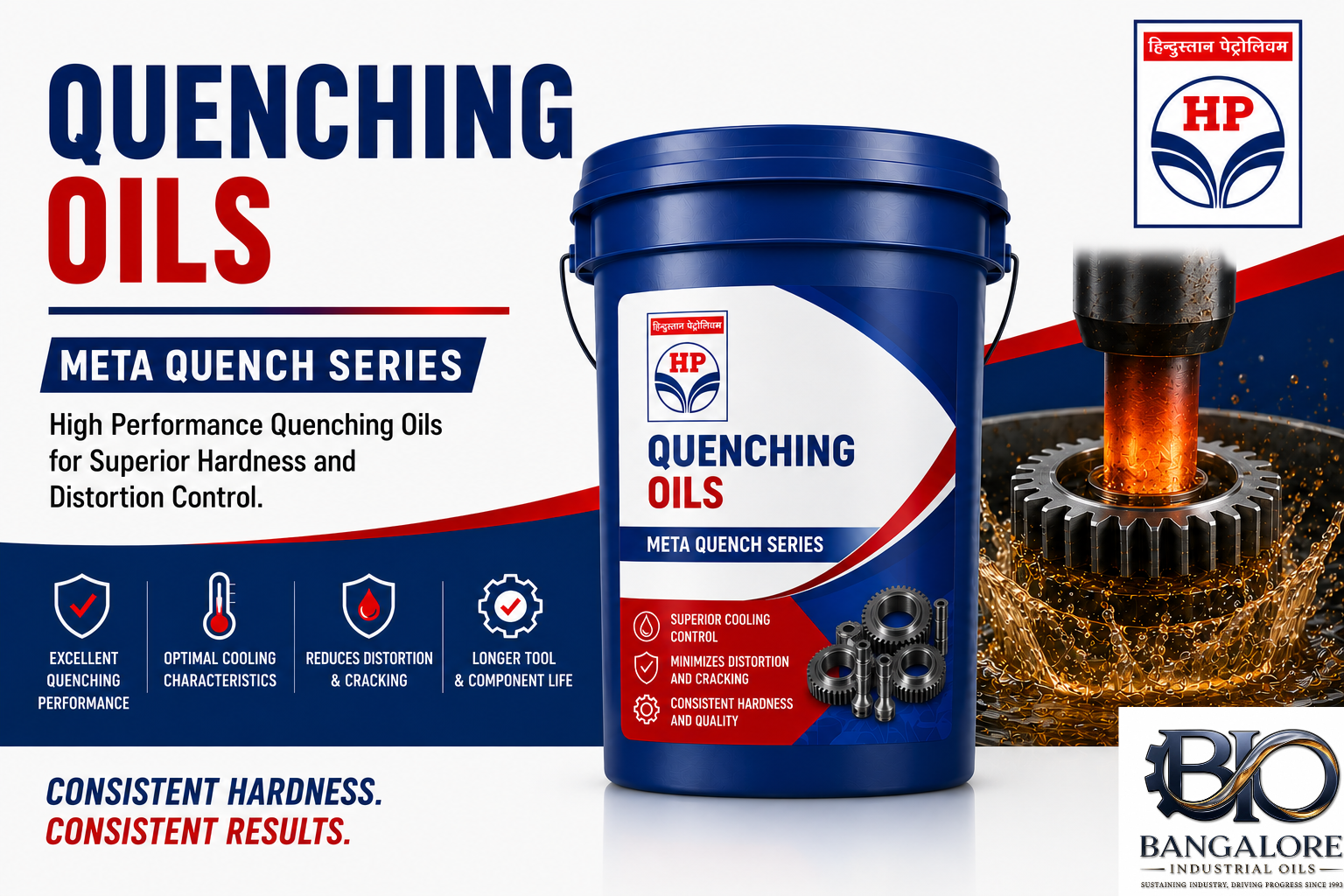 | QUENCHING OILS Looking for reliable Quenching Oils dealers in Karnataka? Bangalore Industrial Oils is a trusted supplier offering high-quality quenching oils... View product → |
How contamination, ageing and bath checks change performance
A bath that still looks usable can already be outside its accepted operating condition. Water in straight industrial quenching oil flashes to steam on hot steel, causing violent bubbling or ejection, local cooling differences, soft spots, staining, corrosion and higher fire risk. Metal fines reduce cleanliness.
Oxidation raises viscosity and acidity and produces sludge, varnish, odour and carbon deposits. Deposits on heaters create hot spots, while poorer heat transfer causes slower or uneven cooling.
In humid coastal storage such as Mangaluru, keep drums sealed, dry and covered, use clean transfer equipment, and protect tank breathers. A quenching oil supplier should provide batch identification and a certificate of analysis or conformity.
Use this written routine:
- Inspect appearance and odour each shift.
- Test water at the supplier’s stated frequency.
- Check viscosity and flash point against the unused reference and supplier limits.
- Filter at the specified flow; compare insolubles or sludge and acid number where specified.
- Record every top-up by product, batch and volume.
| Check | Warning sign | Response |
|---|---|---|
| Water | Bubbling, ejection or uneven cooling | Investigate immediately |
| Viscosity or acidity | Rising values against the unused reference | Review oxidation and filtration |
| Cooling curve | Trend moves outside historical process behaviour | Check hardness, distortion and bath condition |
| Sludge or deposits | Heater hot spots or poorer heat transfer | Inspect equipment and oil |
A cooling curve alone is not a complete acceptance test. Replace the bath when supplier limits, contamination results, cooling-curve trends or process capability show that it has left the validated window. Never blend an unapproved product.
Frequently asked questions
How does quench oil remove heat from hot steel?
It removes heat through a vapour blanket, rapid nucleate boiling and slower convection as the steel cools.
Which parts and processes suit different quench oil types?
Select the grade according to part size, steel hardenability, required cooling speed, distortion risk and whether you use immersion, circulation or spray quenching.
How do you run and size a quench oil bath?
Set the bath temperature, oil volume, agitation and circulation rate for the load, then confirm that the tank, heat exchanger and filtration system can manage the heat input.
What should you request when buying Meta Quench oil in Mangaluru?
Request the exact grade, sealed-pack details, batch number, technical data sheet, safety data sheet and delivery documentation from the quenching oil supplier.
How do contamination and ageing affect quench oil performance?
Water, scale, sludge and oxidation change cooling behaviour, so inspect the bath, test viscosity and water content, filter debris and replace degraded oil.