

Elasto 245, Elasto 541 and Elasto 710 are rubber-process-oil grades, not ISO VG machinery lubricants, so the product number alone cannot establish interchangeability. By the end, you will have a specification checklist, a grade-selection method and receiving controls for comparing these oils without confusing compound-processing requirements with bearing or gear lubrication.
Key takeaways
- Treat 245, 541 and 710 as product identifiers, not ISO viscosity grades.
- Match oil choice to rubber compound, process temperature and compatibility data.
- Request the current TDS, SDS, batch number and licence documents before receiving stock.
- Trial substitutes by measured dosage and compare compound properties before production approval.
What the Current HP Technical Data Sheet Must Specify
Treat Elasto 245, Elasto 541 and Elasto 710 as application-specific process oils, not ISO viscosity grades. The numbers are product identifiers: Elasto 710 is not “ISO VG 710”, and a higher number does not prove higher viscosity or interchangeability.
| Grade | Current HP TDS revision date | Kinematic viscosity | Density | Flash point | Solvency indicator | Pour point | Aromatic or PAH information | Colour | Water | Methods |
|---|---|---|---|---|---|---|---|---|---|---|
| Elasto 245 | Record current date | 40 °C and/or 100 °C value | Value | Value | Aniline point or equivalent | Value | Published statement or “not stated” | Value | Value | D445, D4052/D1298, D92/D93, D1500 |
| Elasto 541 | Record current date | 40 °C and/or 100 °C value | Value | Value | Aniline point or equivalent | Value | Published statement or “not stated” | Value | Value | D445, D4052/D1298, D92/D93, D1500 |
| Elasto 710 | Record current date | 40 °C and/or 100 °C value | Value | Value | Aniline point or equivalent | Value | Published statement or “not stated” | Value | Value | D445, D4052/D1298, D92/D93, D1500 |
Ask the supplier for the current HP technical data sheet and a batch-specific certificate of analysis before quoting customers. Interpret every number against that document’s test method and stated acceptance limits, not invented universal limits.
A general purpose machinery oil wholesaler should also confirm that the buyer needs rubber process oil, since machinery-oil specifications do not establish Elasto equivalence.
How to Choose 245, 541 or 710 for a Rubber Compound
Choose by compound behaviour, not by the number on the drum. Elasto Series 245, 541 and 710 are application-specific rubber process oils, not a viscosity ladder.
| Grade | TDS application map | Starting selection question |
|---|---|---|
| Elasto 245 | Tyre compounds, conveyor belts and hoses | Does the compound need strong incorporation and filler wetting? |
| Elasto 541 | Footwear, moulded goods and general rubber articles | Will the oil support the required hardness, surface finish and processing? |
| Elasto 710 | Reclaimed rubber and selected moulded or tyre compounds | Does the formulation need workable reclaimed-rubber processing without excessive softening? |
Confirm this application map against the current manufacturer TDS revision before quoting. “Light”, “medium” and “heavy” do not establish equivalence between grades or suppliers.
Check polymer polarity and saturation first. Natural rubber, SBR and BR commonly need different solvency and flexibility balances from polar NBR; saturated EPDM often favours a paraffinic-compatible option. Then assess carbon black, silica or mineral filler type and loading, target Shore hardness, low-temperature flexibility, and whether oil changes extrusion pressure, die swell or calendering smoothness.
Run a controlled laboratory trial at the intended dosage. Record Mooney viscosity, cure time and torque, Shore hardness, tensile strength, elongation, compression set or rebound, and heat-ageing results. Compare the finished compound, not viscosity alone.
For rubber process oils in Belagavi, request the current TDS and batch certificate, then qualify the actual compound before production approval. A matching kinematic viscosity does not prove compatibility, cure stability or performance.
Process Oil, Machinery Oil and Alternative Oil Families Are Not Interchangeable
Process oil is incorporated into rubber during mastication, mixing, extrusion or calendering. Machinery oil remains a lubricant for bearings, gears, slides and circulating systems; it is not a rubber-compound ingredient.
| Family | Function | Selection point | Main risk |
|---|---|---|---|
| Elasto rubber process oil | Helps processing and controls compound properties | Match polymer, filler, cure system and flexibility target | It lacks the equipment-grade antiwear, extreme-pressure, demulsification and oxidation-control performance required by machinery makers |
| General-purpose machinery oil | Lubricates bearings, gears, slides and circulating systems | Specify viscosity grade, additive package and equipment compatibility | Its additives can disrupt rubber cure, filler dispersion, hardness, tensile strength or other physical properties |
| Naphthenic process oil | Rubber plasticisation with good solvency and low-temperature flexibility | Useful where cold flexibility and solvency matter | Confirm compatibility and volatility in the finished compound |
| Paraffinic process oil | Lower-solvency processing support | Suitable for applications such as many EPDM formulations | Poor matching can reduce dispersion or alter hardness |
| Aromatic process oil | Strong solvency for difficult polymer or filler systems | Consider only with formulation and compliance review | Staining, volatility, regulatory limits and PAH concerns can restrict use |
Do not quote an Elasto grade until you know the actual rubber application, polymer, filler loading and cure system.
A search for general purpose machinery oil wholesalers elasto series for specifications in belagavi can hide this category error; rubber processing oil wholesalers hp should confirm that the enquiry concerns a compound ingredient, not a machine lubricant.
Treat Elasto 245, 541 and 710 as application-specific process oils, using the current technical data sheet and certificate of analysis to verify suitability.
How to Add the Oil and Compare a Substitute Without Over-Oiling
Add an Elasto grade only after the polymer can carry shear. Adding oil too early lubricates the mixer, reduces shear and leaves filler poorly dispersed; over-oiling lowers hardness, increases bleed and can alter cure behaviour.
1. Begin with polymer mastication until it forms a workable band or charge.
2. Add the process oil only after that point, in measured portions with the filler rather than as one large dose.
3. Keep mixer and batch temperatures within the compounder’s established recipe limits. Do not copy a temperature from another grade without qualification.
4. For general purpose machinery oil wholesalers handling rubber process oils in Belagavi, compare delivered viscosity and chemical data, not “light,” “medium” or “heavy” descriptions.
| Control | Hold constant | Record and compare |
|---|---|---|
| Substitution basis | — | Use the current technical data sheet and batch-specific certificate of analysis; check test methods and values. |
| Recipe | Polymer, filler, curatives, mixing energy and batch size | Record the oil mass and confirm the replacement is not being added at a different phr rate. |
| Mixing | Established mixer limits | Record batch temperature and total mixing time. |
| Compound performance | — | Compare Mooney result, cure curve, hardness, tensile properties and ageing. |
| Decision | — | Reject apparent equivalence if viscosity matches but dispersion, cure, hardness, tensile strength or ageing changes. |
Wholesaler Documents and Receiving Checks for Belagavi Buyers
For general purpose machinery oil wholesalers, Elasto Series specifications in Belagavi begin with supplier traceability, not price. Rubber processing oil wholesalers using HP supply should verify the exact product category, current authorization and batch documents before accepting a quotation.
Request one document pack containing:
- Product name, exact grade, pack size and current technical data sheet.
- Safety data sheet, batch-specific certificate of analysis and tax invoice.
- HP authorization or channel document covering the territory and product category, where authorised supply is claimed.
- Manufacturing date, retest or shelf-life policy, loading temperature and transport classification.
- Confirmation of the supplied format: drum, IBC or bulk.
Bangalore Industrial Oils can be relevant when a Belagavi buyer needs a local industrial-oil channel, but the buyer must still verify the current authorization and documents for the exact Elasto grade and batch.
Confirm the logistics format before dispatch; it affects contamination exposure and landed handling work.
| Format | Receiving point |
|---|---|
| Drum | Check bung seal, lining and dents |
| IBC | Check valve, cage and tamper evidence |
| Bulk | Check tank cleanliness, hose and delivery record |
At receiving, compare the label with the purchase order for grade, net quantity, batch number and manufacturing date. Inspect the seal, drum condition, leaks, water ingress, dirt and damaged lining before signing; quarantine discrepancies and photograph them.
Store closed containers away from heat, direct sunlight, water and strong oxidising materials.
Related product
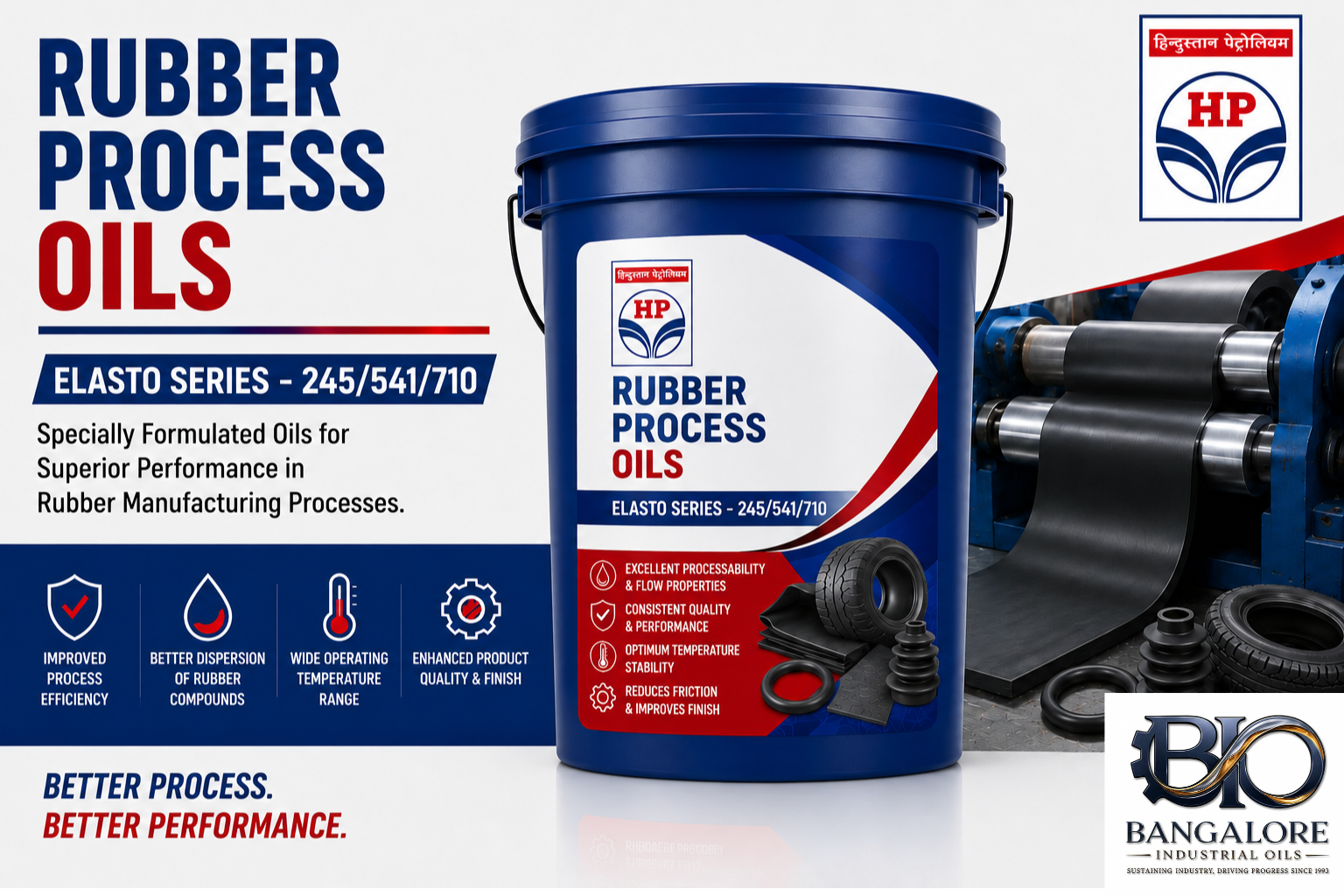 | RUBBER PROCESS OILS Searching for trusted Rubber Process Oils dealers in Karnataka? Bangalore Industrial Oils is a leading supplier offering premium-quality rubber... View product → |
Frequently asked questions
What should the current HP technical data sheet specify?
Ask for the exact product name, application, physical properties, test methods, typical values, handling guidance, revision date and manufacturer identification. Match the document to the drum label and batch paperwork.
How do you choose between Elasto 245, Elasto 541 and Elasto 710?
Do not choose by the product number or assume that a higher number means higher viscosity. Select the oil against the rubber compound, mixing process, target hardness, cure behaviour, compatibility and the supplier’s current technical data.
Can process oil, machinery oil and other oil families be substituted for one another?
No. Rubber process oils, machinery lubricants and other specialty oil families serve different functions. Check viscosity, additives, volatility, aromaticity, compatibility and contamination risks before considering a substitution.
How should a wholesaler compare a substitute without over-oiling the compound?
Keep the formulation dosage controlled by mass, record the original oil-to-polymer ratio, run a small trial and compare mixing time, hardness, tensile properties, cure results and surface appearance before production approval.