Choosing pumpset oil starts with identifying the lubricated component, the engine maker’s specification and the conditions under which the set operates. By the end, you will have a change schedule, a safe refill method and a precise request to make when comparing pumpset engine oil dealers in Hubballi.
Key takeaways
- Follow engine-hour and first break-in service intervals.
- Use the engine maker’s specified viscosity and API performance grade.
- Drain warm oil, replace the seal, and verify the level on level ground.
- Ask Hubballi dealers for batch details, invoice, and product specification data.
When a Pumpset Needs an Oil Change
Use the engine maker’s operating-hour interval and first break-in service as the primary schedule in any pumpset oil replacement guide. If the set runs rarely, apply the maker’s calendar limit as well; an engine that accumulates few hours can still age its oil through moisture and oxidation.
Shorten the interval when the pumpset faces heavy dust, high load, extended idling, frequent short runs, fuel contamination, water ingress or other severe duty. Do not wait for the scheduled date if you find:
- Falling oil level, a rising level or a strong fuel smell.
- Milky oil, sludge or metallic particles on the dipstick or drain plug.
- Low oil pressure, abnormal knocking or persistent ticking.
Dark diesel oil alone does not prove that replacement is due. Soot can darken fresh oil quickly, while depleted additives, fuel dilution, water and viscosity loss can remain invisible. For critical equipment, send a properly collected oil sample to a laboratory; the report can identify fuel dilution, water, viscosity loss and additive depletion.
Record the engine hours at every change, the quantity added between changes, the oil-filter replacement date, and each abnormal noise or leak. A sudden rise in topping-up volume or a new sound deserves investigation before you simply replace the oil and resume operation.
Identify Which Pumpset Component Needs Lubricant
“Pumpset oil” usually means diesel engine crankcase oil, not every lubricant used in the set. Engine oil circulates through the sump, bearings, piston-cylinder area and valve train.
| Component | Lubricant to verify | Do not assume |
|---|---|---|
| Engine crankcase | Engine oil matching the manual | Viscosity alone does not prove compatibility |
| Pump bearing housing | Grease or separate bearing oil | Do not fill with engine oil |
| Gearbox | Gear oil, such as the grade on its plate | Engine oil is not a substitute |
| Hydraulic circuit | Hydraulic fluid | Use the specified viscosity and fluid type |
| Coupling | Lubrication specified for its design | Some couplings are sealed or dry |
A gearbox grade printed on its plate takes priority. A pump bearing may need grease or a dedicated bearing oil; none of these points should receive engine oil without the manufacturer’s instruction.
Before draining, complete this checklist:
- Stop the engine and isolate the starter or electrical supply.
- Close fuel or water controls where required.
- Let hot parts cool enough to prevent burns.
- Place the set on level ground.
- Fit a drain pan and locate the drain plug.
- Identify the filler and dipstick.
- Prepare a sealed container for used oil.
Record the engine make, model, serial number and rated speed before contacting pumpset engine oil dealers. Include the pump component requiring lubricant, because ordering only “pumpset oil” can put engine, gear or hydraulic oil in the wrong housing.
How to Choose Between 20W40, 15W40 and SAE 30
A search for pumpset oil 20w40 in hubballi does not establish that SAE 20W40 suits your engine. SAE 20W40 is a viscosity classification under SAE J300: 20W describes low-temperature flow performance, while 40 describes viscosity at operating temperature. The grade says nothing about detergency, soot handling, oxidation control, antiwear performance or base oil.
| Option | What it means | What it does not prove |
|---|---|---|
| SAE 20W40 | 20W low-temperature classification and 40 operating-temperature grade | That the additive package or engine approval is correct |
| SAE 15W40 | Lower winter viscosity classification than 20W40, with the same 40 operating-temperature grade | That it can replace 20W40 in every engine |
| SAE 30 | Single-grade oil without a W winter classification | That it suits the same temperature range or specification |
Match the engine manual’s SAE grade, API service category and proprietary engine-maker approval before comparing products. Then check whether the engine is air-cooled or liquid-cooled, the ambient temperature in Hubballi, rated load, operating speed and dust exposure.
API CK-4, FA-4, CJ-4, CI-4, CH-4 and CF are not interchangeable simply because each appears on a diesel-oil label; use the category named by the manual. Specify the complete requirement, such as SAE 20W40 plus the required API category or OEM specification, rather than ordering only “pumpset oil 20W40.”
Drain, Refill and Verify the Oil Correctly
Use this pumpset oil replacement guide to change crankcase oil without burns, contamination or a false level reading. Warm the engine only enough to make the oil flow and suspend contaminants. Stop it, isolate the starter or electrical supply, and wait until the drain plug, filter and nearby surfaces are safe to touch.
- Place the pumpset on level ground and position a drain pan under the drain plug.
- Remove the filler cap only if the engine manual permits it; this can improve drainage.
- Open the drain plug carefully and inspect the old oil for metal particles, sludge, coolant or a strong fuel smell.
- Replace the oil filter where fitted. Fit a new sealing washer if the old washer is damaged or crushed.
- Tighten the drain plug to the torque specified in the engine manual.
- Add oil through the filler using the quantity in the engine manual, nameplate or maker’s service data.
Capacity is not a target for guesswork. Finish the fill with the dipstick, holding the engine in the position specified by the manufacturer.
| Check | Correct practice | Failure prevented |
|---|---|---|
| Drainage | Let the oil drain fully into a clean pan | Contamination and trapped old oil |
| Filter seal | Inspect the filter seal before tightening | Oil leaks after startup |
| Final level | Use the specified dipstick method | Overfilling or oil starvation |
If the manual permits, run the engine briefly, stop it, inspect the drain plug and filter for leaks, allow oil to settle for the stated time, and recheck the level. Overfilling causes foaming, oil consumption, leakage and crankcase-pressure problems. Store used oil in a closed, labelled container for an authorised collection point.
What to Ask General Purpose Machinery Oil Dealers in Hubballi
Send the dealer the engine make, model, serial number, rated speed, oil capacity, operating hours, air-cooled or liquid-cooled design, current grade, required API category or OEM specification, and number of sets being serviced. “Pumpset oil” is not a complete specification.
- Ask for the product name, SAE grade, API claim, technical data sheet, pack size, sealed-pack condition, batch number, manufacture date, and invoice.
- Request a certificate or declaration supporting the stated API category or OEM specification.
- State that a quotation for pumpset oil 20W40 in Hubballi must include the complete engine requirement, not viscosity alone.
Compare the quotation this way:
| Quotation line | What it identifies | What goes wrong if unclear |
|---|---|---|
| Crankcase engine oil | Oil circulating through the engine sump, bearings and valve train | The engine receives an unsuitable lubricant |
| Pump-bearing grease or bearing oil | Lubricant for the pump bearing housing | Engine oil is forced into a bearing that needs grease or separate oil |
| Gear oil or hydraulic fluid | Lubricant for a gearbox or hydraulic circuit | A generic “pumpset oil” order fills the wrong component |
A search for general purpose machinery oil dealers pumpset oil for change in Hubballi should lead to a documented match, not a brand or viscosity guess. Bangalore Industrial Oils can provide a local point for checking HP and other industrial lubrication products against that requirement.
Retain the label, batch details and invoice, avoid mixing products during a change unless the engine maker permits it, and follow the manual’s disposal instructions for used oil and filters.
Related product
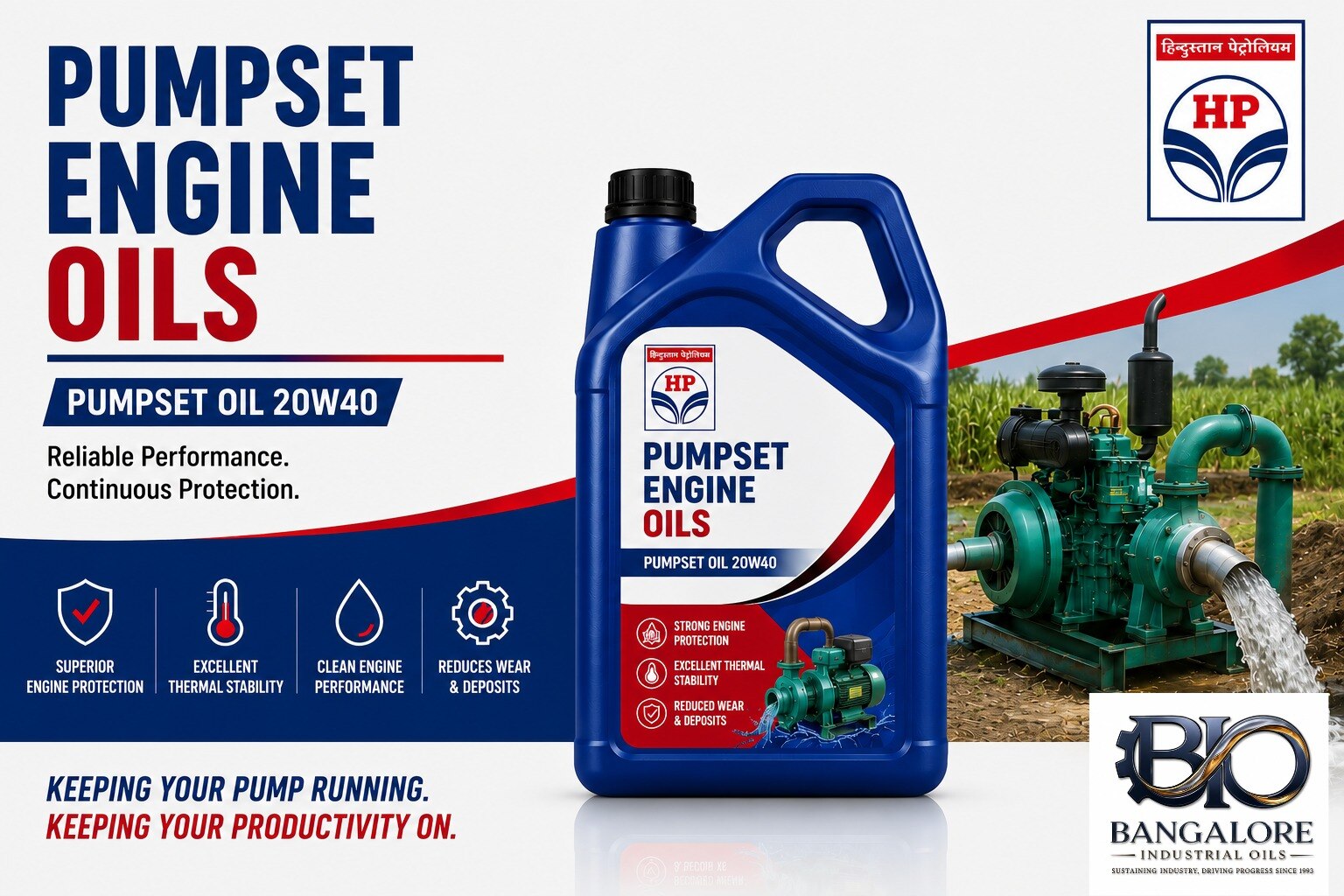
 | PUMPSET ENGINE OILS Bangalore Industrial Oils is a reliable dealer of PUMPSET OIL 20W40 Engine Oil, offering high-performance lubrication solutions specially formulated... View product → |
Frequently asked questions
When does a pumpset need an oil change?
Use the engine maker’s operating-hour interval and first break-in service as the primary schedule. Apply the maker’s calendar limit when the pumpset runs rarely because moisture and oxidation still age the oil.
Which pumpset component needs lubricant?
Identify the engine crankcase, pump bearing housing, gearbox, and other lubrication points separately. Check the owner’s manual because engine oil is not automatically suitable for pump bearings or gearboxes.
How do you choose between 20W40, 15W40 and SAE 30 pumpset oil?
Choose the viscosity and API performance grade specified by the engine maker. Compare the manual’s requirement with the label; do not substitute 20W40, 15W40, or SAE 30 by viscosity alone.
How do you drain, refill and verify pumpset oil?
Run the engine briefly to warm the oil, shut it down safely, drain it into a container, replace the drain-plug seal when required, refill to the marked level, and check for leaks after restarting.
What should you ask pumpset engine oil dealers in Hubballi?
Ask for the exact product grade, API classification, batch number, manufacturing date, sealed-pack condition, invoice, and storage history. Confirm that the oil matches your engine maker’s specification.