Choosing between Meta Quench grades requires more than matching a viscosity number or selecting the oil with the highest stated cooling rate. You will be able to compare each verified grade against the same cooling-curve method, operating conditions, steel application and purchasing evidence before approving it for production.
Key takeaways
- Compare grades under identical bath temperature, agitation, load and immersion conditions.
- Use cooling-curve data to match conventional, accelerated or martempering oil to the job.
- Choose viscosity and cooling speed alongside steel grade, section size and distortion risk.
- Verify batch traceability, technical data and storage controls before buying from an HP wholesaler.
How to Build a Fair Meta Quench Series Comparison
A fair meta quench series comparison uses identical test conditions for every grade, not catalogue viscosity or product names. Test each oil at a bath temperature representative of production, with the same agitation, load, immersion arrangement and steel probe. Room-temperature technical-data-sheet values cannot replace in-service cooling-curve data.
| Information to record | What to compare for every grade | Why it matters |
|---|---|---|
| Cooling curve | Maximum cooling rate, temperature at maximum rate, and cooling time through about 800–400 °C | Shows hardening response across the critical transformation range |
| Operating data | Recommended operating temperature and usable bath-temperature range | Reveals whether the grade suits your furnace and production cycle |
| Physical and safety data | Kinematic viscosity at a stated temperature, flash point and supplier temperature limit | Separates flow behaviour from fire-risk controls; flash point is not an operating target |
| Bath durability | Oxidation resistance, sludge or varnish tendency, and inspection or replacement limits | A fresh-oil result may not predict performance in a working tank |
| Process result | Hardness profile, distortion, cracking, staining and scale under the same workload | Prevents a faster cooling rate from being mistaken for a better result |
1. Match the comparison to the actual steel, section size, furnace exit temperature and transfer time. An oil suitable for small parts may fail to harden a heavy section.
2. Treat “bright quench” as a staining or scale claim, not proof of maximum cooling. Judge brightness, distortion and hardness separately.
3. Record results at equal bath condition and repeat after representative service exposure before declaring one grade superior.
Conventional, Accelerated and Martempering Oils: What the Grades Change
The grade changes the cooling curve, not simply the oil’s label. Compare maximum cooling rate, temperature at that maximum and cooling time through roughly 800–400 °C under identical bath temperature, agitation and load conditions.
| Option | Cooling behaviour and use | Operating temperature and bath range | Flash point, viscosity and ageing |
|---|---|---|---|
| Conventional cold quench oil | Moderate cooling; suits general carbon and alloy-steel hardening where distortion risk must be controlled | Use within the supplier’s validated range; conventional oils commonly measure about 15–30 mm²/s at 40 °C | Maintain a substantial margin below the stated flash point; moderate viscosity does not prove quench severity. Oxidation raises acidity, sludge and viscosity |
| Accelerated quench oil | Additives increase heat extraction and shorten the high-temperature cooling stage; useful when conventional oil does not deliver required hardness | Use only across the specified temperature window, with controlled agitation and foam monitoring | Do not treat flash point as an operating temperature. Additive depletion and oxidation can reduce wetting and make cooling inconsistent |
| Martempering oil | Designed for staged cooling: hold steel above the transformation range, then cool more uniformly to reduce cracking and distortion | Runs at an elevated, tightly controlled bath temperature; its usable range is narrower if the cooling curve shifts outside the process window | Confirm flash-point margin, viscosity and oxidation limits at service temperature; ageing can change the holding behaviour |
A higher-viscosity oil increases drag-out and can restrict circulation through complex loads. Select among these quenching oil options only after matching the actual cooling curve, flash point, viscosity, oxidation data and validated bath-temperature range to the workpiece and tank.
Selecting a Grade for Steel, Section Size and Distortion Risk
Carbon steel and heavy sections usually need the faster cooling of an accelerated Meta Quench grade; thin, high-carbon or distortion-sensitive parts need less severity. Choose from quenching oil options by hardenability, section thickness and required hardness profile, not steel name alone.
| Meta Quench type | Suitable starting point | Main risk to control |
|---|---|---|
| Conventional cold quench oil | Thin carbon-steel parts, small gears, springs and moderate-hardenability alloy steel | Insufficient core hardness in thick sections |
| Accelerated quench oil | Low-hardenability carbon steel, heavy shafts, large gears and sections needing deeper hardening | Higher residual stress, cracking and dimensional movement |
| Martempering oil | Tool steel, bearings, precision gears and distortion-sensitive alloy-steel components | Lower severity can leave a soft core if the section exceeds the steel’s hardenability |
| Bright quench grade | Parts where reduced staining matters after a suitable quench selection | “Bright” describes surface appearance, not maximum cooling rate |
For carbon steel, select accelerated oil only when the section requires its greater cooling rate; a conventional grade can reduce cracking in thin parts. Alloy steel usually permits a slower conventional or martempering grade because alloying increases hardenability.
Bearings, tool steel and precision gears favour martempering when dimensional movement matters. Shafts and large gears often need accelerated oil, while springs need enough surface hardness without creating quench cracks at sharp bends or stamped edges.
Confirm the choice with cooling-curve data: maximum cooling rate, its temperature, and time through roughly 800–400°C. Compare candidates at the same bath temperature, agitation and load. A supplier’s steel-grade recommendation is incomplete without section size, transfer time and furnace exit temperature.
Production Controls That Make the Cooling Curve Repeatable
A repeatable cooling curve depends more on the bath and the transfer routine than on the oil name. Hold the same temperature, circulation, load, and immersion method for every Meta Quench grade; otherwise, a supplier’s laboratory curve cannot predict your tank.
1. Set the bath to the intended production temperature and record it at several points, not only at the controller. Keep the temperature within your defined band before loading and measure the recovery after each batch.
2. Run the pump and agitation system at a fixed, recorded setting. Check flow direction, impeller position, and oil level; a low level or blocked return changes local heat transfer.
3. Keep the charge consistent. Record workpiece mass, basket dimensions, spacing, and surface area, then avoid overloading the tank. A crowded basket creates a hotter, slower-moving zone.
4. Transfer parts from the furnace within a fixed number of seconds. Start the timer at furnace exit, and keep the path and handling equipment unchanged between batches.
5. Immerse parts in the same orientation and at a controlled speed. Place long shafts vertically or horizontally according to the validated procedure, and prevent parts from touching the tank, basket, or one another.
6. Maintain agitation through the high-temperature cooling stage, then withdraw at a defined rate. Uneven withdrawal can leave soft bands or distort thin sections.
7. Inspect and clean the bath for water, furnace scale, salts, sludge, and tramp oil. Filter or replace oil when contamination, foaming, viscosity change, or cooling-curve drift appears.
For comparison testing, state the probe, bath temperature, agitation, load, and calculation method. ASTM D6200 and ISO 9950 produce different test descriptions, so their cooling-rate figures cannot be ranked as though they were identical.
What to Verify When Buying Through an HP Wholesaler
Do not treat two Meta Quench grades as interchangeable until the HP channel proves both product identity and process fit.
From quenching oil wholesalers hp, request these records for each grade:
- Current technical data sheet (TDS), safety data sheet (SDS) and certificate of analysis (CoA).
- Exact product name, batch number, manufacture date, fill date and expiry or retest guidance.
- Unbroken seal evidence, container photographs and storage history, including exposure to heat, water or mixed oils.
- Cooling-curve report stating whether the procedure used ASTM D6200 or ISO 9950, plus probe type, bath temperature, agitation and calculation method.
| Check | Accept as comparable | Reject or investigate |
|---|---|---|
| Cooling behaviour | Maximum cooling rate, peak-rate temperature and 800–400 °C cooling time measured by the same method | Cooling-rate figures with no method or test conditions |
| Process fit | Data for your steel, section size, transfer time, bath temperature and agitation | A general claim that the oil suits a steel grade |
| Safety | Flash point and a written operating limit based on tank design and carry-over risk | Treating flash point as the recommended bath temperature |
Inspect the tank, circulation, agitation, filtration, water contamination and loading pattern before changing grades. Record the existing oil’s condition and compare samples, not labels or viscosity alone.
If Bangalore Industrial Oils is your industrial quenching oil supplier, ask for this traceability package before approving a substitution. An authorised HP channel strengthens provenance; it does not establish equivalence.
Related product
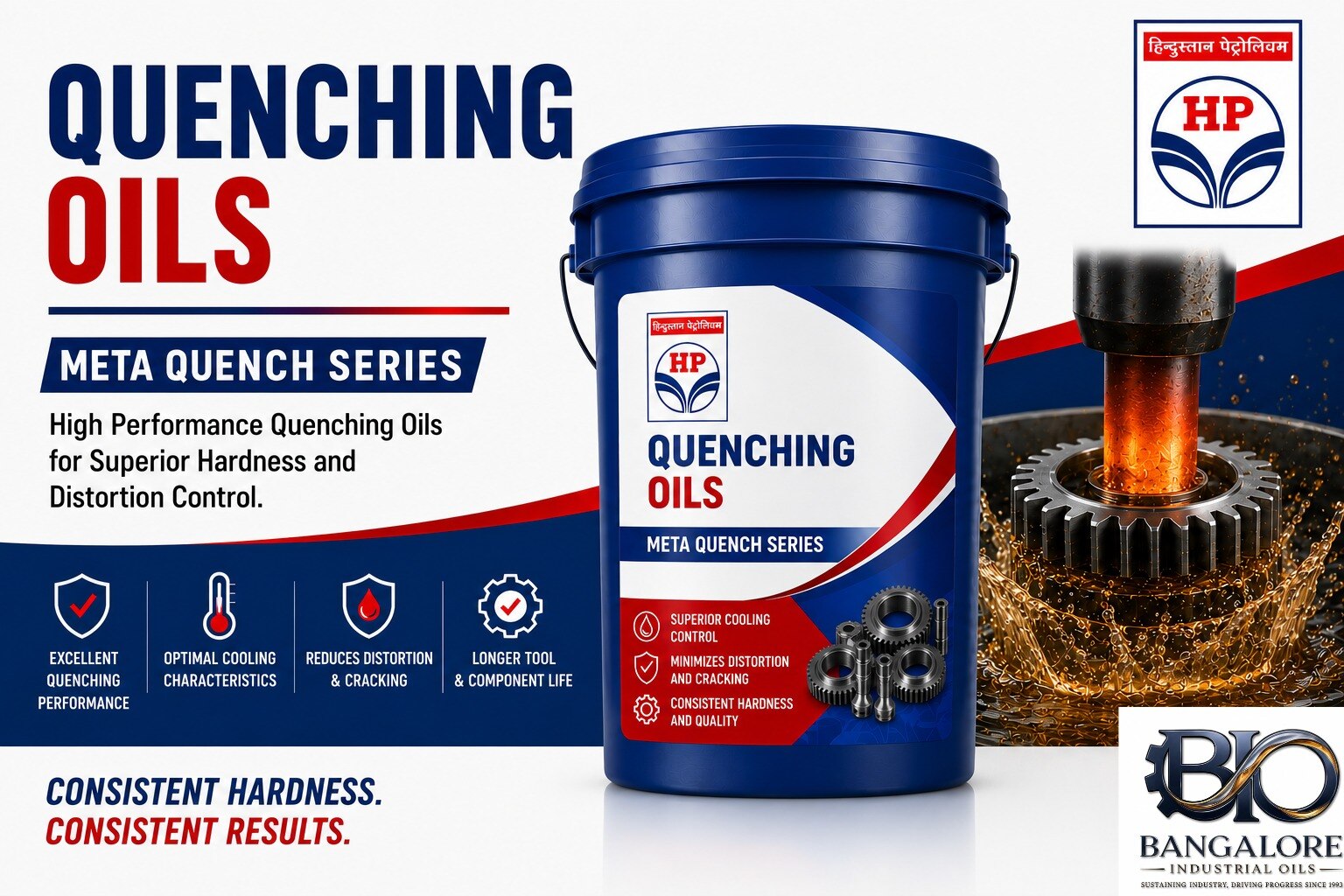
 | QUENCHING OILS Looking for reliable Quenching Oils dealers in Karnataka? Bangalore Industrial Oils is a trusted supplier offering high-quality quenching oils... View product → |
Frequently asked questions
How do you build a fair Meta Quench series comparison?
Test every grade at the production bath temperature using identical agitation, load, immersion arrangement and steel probe. Use in-service cooling-curve data rather than room-temperature viscosity alone.
What changes between conventional, accelerated and martempering quenching oils?
The grades differ in cooling behaviour and the process window they support. Match the oil to the required cooling rate, steel hardenability and distortion limits.
How do you select a quenching oil grade for steel and section size?
Consider the steel grade, part thickness, required hardness and distortion risk together. Larger or harder-to-quench sections need a different cooling response from thin sections or distortion-sensitive parts.
How can production controls make quenching results repeatable?
Control bath temperature, agitation, load arrangement, immersion practice, oil condition and contamination. Record these variables with cooling-curve or hardness checks.
What should you verify when buying quenching oil through an HP wholesaler?
Check the product grade, technical data sheet, batch number, seal condition, traceability documents and storage history. Confirm that the supplied oil matches the approved production specification.