A sugar-mill roll bearing lubricant has to survive water, diluted cane juice, bagasse fines, heavy loads and the actual oil-delivery system. By checking the bearing arrangement, verified product data, changeover method and operating symptoms, you can decide whether a Crushwell grade or a general machinery oil fits the application without relying on a product label alone.
Key takeaways
- Choose oil from bearing load, speed, clearance, heat and seal design.
- Compare Crushwell 2, 3 and 4 with verified viscosity and OEM data.
- Confirm the feed method before changing oil or adjusting delivery.
- Buy against a written specification, batch record and condition-monitoring plan.
Choose the lubricant from the bearing arrangement, not the product name
A sugar-mill roll-bearing lubricant is necessary when the bearing carries high roll loads at low speed, runs hot, or faces water, diluted cane juice, bagasse and abrasive fines. Choose from bearing clearance, load, speed, operating temperature, seal design and the OEM specification—not from the words “sugar mill” on the label.
| Option | Acceptable choice | Reject it when |
|---|---|---|
| Roll-bearing oil | The OEM specifies oil and the sump, sight glass, drip feed or circulation system controls delivery through the bearing. | Narrow passages, poor seals or contamination demand a different arrangement. |
| General-purpose machinery oil | The OEM permits its viscosity and additive system, with moderate load, controlled temperature, effective seals and limited water ingress. | The roll journal needs stronger boundary-film protection, water handling or tackiness. |
| Grease | Only a grease-designed bearing, seal and replenishment system supports it. | The housing is oil-fed; grease can overfill the space, increase heat and block purge paths. |
Crushwell 2, 3 and 4 must be matched to the maker’s stated grade and application; the numbers do not prove interchangeability. A search for sugar mill roll bearing oil wholesalers hp identifies a supplier category, not performance.
A heavier or tackier oil is not automatically safer: it can increase churning, drag and start-up heat, trap bagasse, or obstruct narrow passages. Oil and grease are not interchangeable; changing either requires OEM approval, suitable seals, clearance and feed controls.
Compare Crushwell grades with machinery oil using verified data
CRUSHWELL 2, 3 and 4 are manufacturer grades, not proof of ISO VG 2, 3 or 4. Do not approve a substitution from the number alone. Obtain the current technical data sheet for each grade and compare it with the proposed general-purpose machinery oil.
| Product | What the name proves | What you must verify |
|---|---|---|
| CRUSHWELL 2 | Only the manufacturer’s grade designation | Viscosity and test temperature, ISO VG or other grade, operating-temperature range, flash point, pour point, viscosity index, water content or demulsibility, rust and corrosion results, and four-ball or other wear data when provided |
| CRUSHWELL 3 | Only the manufacturer’s grade designation | The same values; confirm the intended sugar-mill roll-bearing application and feed method |
| CRUSHWELL 4 | Only the manufacturer’s grade designation | The same values; do not assume a heavier grade gives safer protection |
| General-purpose machinery oil | A broad application description | Exact viscosity grade, water-separation behaviour, additive system, temperature limits, corrosion results and wear-test evidence |
Water separation can matter more than a “bearing oil” label. Ask for demulsibility results, such as ASTM D1401 where applicable; retained water can cause rust, film failure and premature bearing distress.
Boundary-film performance matters during start-up, shock loading and slow, heavily loaded roll service, while contamination tolerance matters when water, cane juice or bagasse enters the housing.
“EP,” “heavy duty” and “suitable for bearings” do not establish suitability. Ask general purpose machinery oil wholesalers for traceable test data, then compare it against the roll-bearing requirement rather than the litre price.
Match the oil to the feed method and complete the changeover correctly
Feed method determines how much oil stays at the bearing and how contamination leaves. A search phrase such as general purpose machinery oil wholesalers hp identifies sellers, not a suitable grade or delivery method.
| Method | Practical difference | Control |
|---|---|---|
| Oil bath | Bearing elements dip into a fixed oil level; excess oil causes churning and heat. | Use the marked fill line or dipstick. |
| Sight-glass sump | The sight glass shows the operating level, not a housing to fill completely. | Maintain the maker’s indicated level. |
| Drip feed | Oil enters slowly and may be lost with leakage or washout. | Set drops per minute from the OEM instruction. |
| Forced circulation | A pump delivers, filters and returns oil; blocked strainers can starve the bearing quickly. | Set flow, pressure and temperature as specified. |
| Once-through | Oil passes through and drains away, carrying heat and contamination with it. | Set the supply rate and provide safe collection. |
- Drain the old oil while warm, then remove settled water, cane fibres and sludge. Clean strainers and inspect seals for hardening, cuts and leakage.
- Before changing from general machinery oil to a Crushwell grade, between Crushwell grades, or between additive systems, verify compatibility with the lubricant supplier and bearing maker. Flush only when the oils, seals and equipment instruction permit it.
- Check the drained oil and first flush for residual colour, odour, water or incompatible oil. Do not dilute contamination with fresh oil.
- Refill only to the fill line, dipstick mark, sight-glass level or bearing-maker instruction. Overfill creates churning, heat, leakage and foam.
- Start the equipment, confirm circulation or drip rate, then reset feed from the OEM or equipment instruction—not from the product name.
Use temperature, oil condition and failure symptoms to adjust the decision
1. A hot bearing is not automatically asking for heavier oil. Compare the temperature rise with the OEM limit, then check oil level, viscosity change, overfill, blocked delivery lines, misalignment, excessive load and wrong bearing clearance. High drag or restricted circulation can create heat even when the lubricant is correct.
2. Inspect the oil before changing it. Dark oil points to oxidation or overheating; milky oil indicates water or diluted cane juice; foam indicates air entry, overfill, incompatible additives or a blocked return. Test viscosity, water, rust, silica, bagasse fines and wear debris.
Do not add fresh oil to a contaminated sump before correcting water entry, seal damage or the contamination source.
3. Treat abnormal noise and metal particles as possible bearing distress, not merely an oil-grade problem. Check alignment, load, clearance, shaft condition and the bearing itself.
Rapid oil loss and repeated seal failure direct attention to damaged seals, excessive pressure, shaft movement, wrong seal design or a lubricant that is too fluid; leakage can also starve the bearing.
4. Set oil-change or relubrication intervals from oil analysis, operating hours, temperature rise, water contamination and the bearing manufacturer’s instruction—not an unsupported calendar date. After cleaning, confirm feed rate and level.
Searching for bearing oil in Bengaluru does not replace this diagnosis: select Crushwell or general machinery oil only after the evidence matches the OEM arrangement and contamination conditions.
Buy against a written specification, not the lowest litre price
A litre-price quote cannot tell you whether the oil will survive a wet roll bearing. Ask every supplier for a written, like-for-like offer before comparing totals.
- Exact product name and grade, including whether the quotation is for Crushwell 2, 3 or 4
- Sealed-pack condition, batch number and storage age
- Current technical data sheet, plus a certificate of analysis or relevant test results
- Delivery lead time, stock location and technical support for compatibility and changeover
The search phrases general purpose machinery oil wholesalers hp, sugar mill roll bearing oil wholesalers hp, general purpose machinery oil wholesalers and bearing oil in Bengaluru identify sources, not performance. “EP”, “heavy duty” and “suitable for bearings” are claims to verify, not specifications.
| Option | Compare on | Accept only when |
|---|---|---|
| General-purpose machinery oil | Viscosity range, water separation, temperature limit and additive compatibility | The OEM permits it for your bearing and feed system |
| Crushwell grade | Exact manufacturer grade, TDS values, water-handling behaviour and roll-bearing application | The offered grade matches the OEM requirement and operating conditions |
| Unverified substitute | Label, litre price or seller description | Never, without traceable data and written approval |
Evaluate Bangalore Industrial Oils beside other suppliers by asking whether its offered Crushwell grade matches the OEM requirement, feed method, viscosity range, water-handling requirement and operating temperature. Require sealed, traceable supply and written changeover guidance before draining, mixing or flushing the existing oil.
Related product
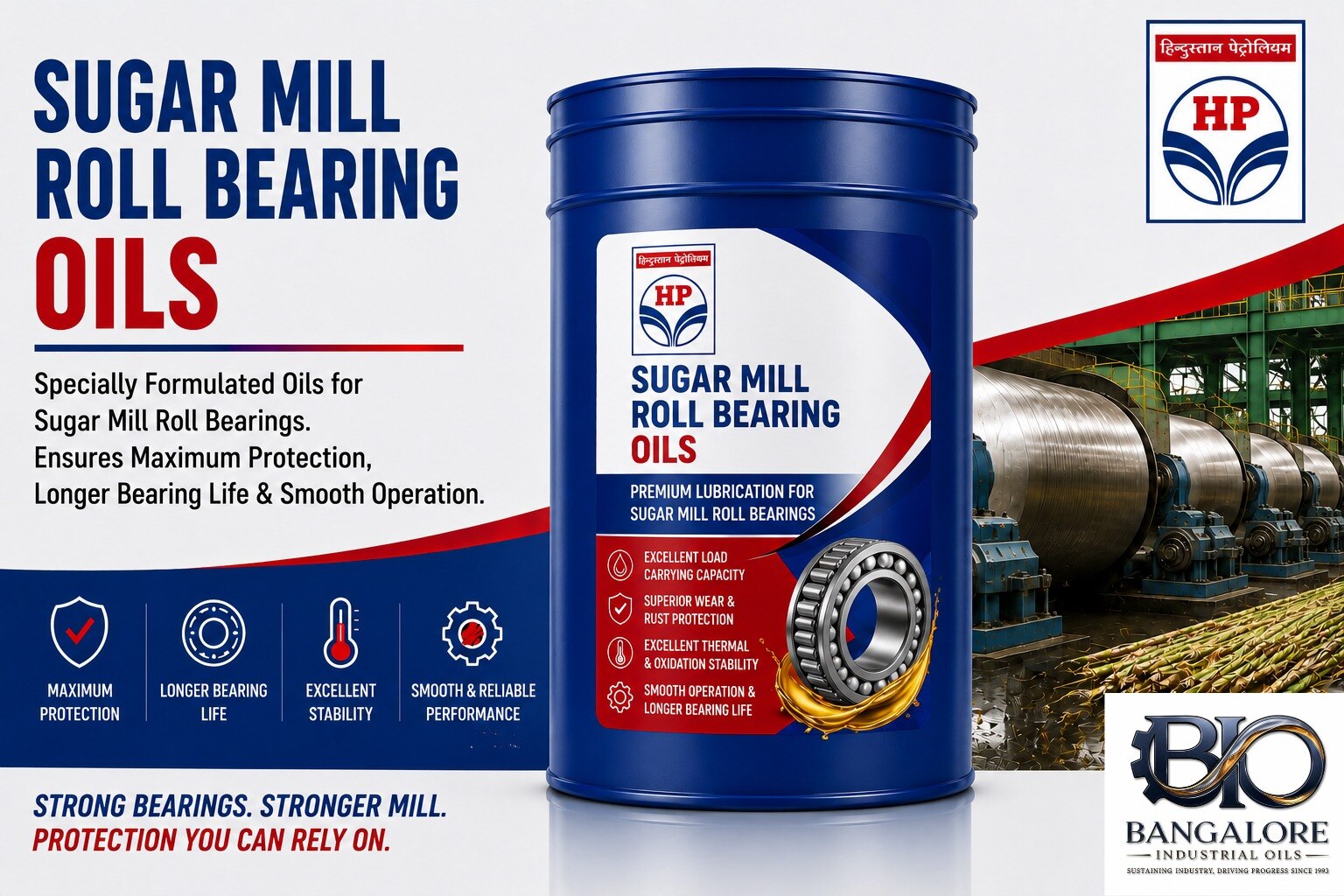
 | SUGAR MILL ROLL BEARING OILS CRUSHWELL - 2/3/4 Bangalore Industrial Oils is a trusted dealer of CRUSHWELL 2/3/4 Sugar Mill Roll Bearing Oils, offering premium lubrication solutions for heavy-duty... |
Frequently asked questions
Should you choose Crushwell or general machinery oil by product name?
No. Select the lubricant from bearing clearance, load, speed, operating temperature, seal design and the OEM specification.
How should you compare Crushwell grades with general machinery oil?
Verify the grade, viscosity, operating-temperature range, additive chemistry, water handling and OEM approval before comparing products.
What must you check before changing the bearing oil?
Check whether the bearing uses an oil bath, drip feed, circulating system or automatic oiler, then drain, flush if compatible, refill and confirm the correct level.
When should you change the lubricant decision after installation?
Review the choice when temperature rises, oil darkens or separates, water enters, metal particles appear, or the bearing develops noise, vibration or repeated failures.