A processing facility cannot choose generator oil from the 15W-40 label or the generator’s kVA rating alone. By the end, you will have a practical comparison method for HP MILCY POWER 15W40, competing oils, engine requirements, maintenance evidence, and supplier documents.
Key takeaways
- Set SAE grade, API category, approval, sump capacity and drain interval first.
- Treat 15W-40 as viscosity information, not proof of engine approval.
- Check emissions hardware, duty cycle and oil samples before extending drain intervals.
- Compare distributors using certificates, batch traceability, delivery records and total operating cost.
Set the acceptance criteria before comparing generator oils
Do not approve HP MILCY POWER 15W40 because it matches a competitor’s 15W-40 label. Set the acceptance criteria from the engine manufacturer’s manual: required SAE grade, API service category, named oil specification or approval, sump capacity, and permitted drain interval.
A 500 kVA generator can use a different oil from another 500 kVA set because the engine model determines the requirement.
| Comparison point | HP MILCY POWER 15W40 | Alternative oil |
|---|---|---|
| Exact performance claim | Record the named API category and OEM approval; do not infer either from the product name | Record the same evidence |
| Technical data | Compare TDS viscosity values, flash point, pour point, sulphated ash and other stated tests | Compare identical TDS fields |
| Traceability | Check sealed packaging, pack size, batch or lot number and manufacturing date | Check the same details |
| Maintenance fit | Confirm the engine-maker drain interval, not a distributor’s generic interval | Confirm against the same manual |
| Supply evidence | Require TDS, SDS, tax invoice and current HP-channel authorisation when applicable | Require equivalent seller documentation |
Use generator oil comparison as a documented pass-or-fail exercise. The phrase generator oil distributors hp milcy power for comparison in bengaluru describes a sourcing search, not an oil specification.
- Reject a bid that omits the exact product name, grade, batch details or manufacturing date.
- Treat “HP-authorised” as channel status, not proof of oil performance.
- Include used-oil collection records and an authorised disposal route; never permit discharge to soil or drains.
Read 15W-40 correctly: viscosity is not an approval
SAE 15W-40 describes viscosity, not overall oil quality or engine approval. Under SAE J300, the 15W rating covers cold cranking at −20 °C and cold pumping at −25 °C; the SAE 40 rating requires a kinematic viscosity of 12.5–16.3 mm²/s at 100 °C.
That grade alone cannot prove suitability. Two 15W-40 oils can use different detergent, dispersant, anti-wear and low-ash additive systems. An oil with the right viscosity can still fail an engine-maker specification or damage diesel particulate filters, oxidation catalysts and other after-treatment hardware.
The phrase generator oil distributors HP may describe an HP-branded lubricant distributor, a high-power generator application or a locality-based supplier. It is not a technical approval.
Before accepting Milcy Power 15W40, record:
- The engine manual’s required SAE grade and oil specification.
- The exact API performance category printed on the container or technical data sheet.
- A named OEM approval or performance claim, without treating “recommended for” as approval.
- TDS values, including viscosity, sulphated ash and pour point where relevant.
- Pack size, batch number, manufacture date and seal condition.
- The engine maker’s permitted drain interval and sump capacity.
If the documentation does not state an API category or OEM approval, mark that information as unverified. Do not infer it from 15W-40, the HP brand, generator kVA or the distributor’s claim.
Match the oil to the engine, duty cycle and emissions hardware
A 500 kVA generator does not identify its correct oil. Two sets with the same rating can use different engine models, sump capacities, API categories and drain intervals. Select against the engine manual and duty cycle, not the alternator brand, generator size or product name.
| Basis | HP MILCY POWER 15W40 | Another 15W-40 |
|---|---|---|
| Engine fit | Confirm the engine maker’s required SAE grade, API category and named approval; do not assume suitability from the label | Check the same requirements, because equal viscosity does not mean equal additive performance |
| Duty cycle | Apply the engine maker’s interval for standby, prime or continuous service, then confirm the oil’s TDS supports that use | Compare its stated limits and the approved drain interval under the same load profile |
| Emissions hardware | Verify compatibility with the engine’s EGR, diesel oxidation catalyst, diesel particulate filter or SCR system | Reject it if the manual requires a specification or approval the product cannot document |
Before approving either oil, verify:
- The exact engine model and serial range, SAE viscosity, API service category and manufacturer specification in the manual.
- Whether after-treatment hardware changes the required ash, phosphorus or sulfur limits; a newer API category is not automatically approved for every engine.
- The expected load pattern: short standby runs, frequent prime-power starts, or long continuous operation.
- Batch date, TDS values and named OEM approval claims for Milcy Power 15W40; if those documents are absent, do not infer them from 15W-40.
- Avoid routine mixing with another oil. Use a compatible emergency top-up only to prevent low-level operation, then drain and replace the filter under controlled conditions. This applies when selecting industrial generator oil in Bengaluru as well.
Control oil condition through filling, sampling and changeout
Fill to the engine maker’s marked level, not to the top of the dipstick. Use the specified SAE grade and product, keep the filler cap and funnel clean, and record oil quantity, engine hours and batch number. Do not mix oils during a top-up unless the manufacturer confirms compatibility.
Inspect the oil and engine at every planned service:
- Check the level trend; a falling level indicates consumption or leakage, while a rising level can indicate fuel dilution or coolant entry.
- Look for milky oil, diesel smell, foam, sludge, metallic glitter and abnormal darkening.
- Inspect the crankcase breather, seals, filter housing and drain plug for leaks.
- Check air filtration, room ventilation and exhaust loading; dust, high temperature and repeated light-load running accelerate oil degradation.
Take a warm sample after the engine has operated under load. Use a clean laboratory bottle, avoid the first drain flow, and label the engine model, oil grade, hours on oil, total hours and top-ups. Request viscosity, fuel dilution, water, coolant markers, soot, oxidation, nitration, wear metals and total base number.
A generator oil comparison is incomplete without used-oil evidence.
Change oil at the engine maker’s hour or calendar limit, whichever arrives first. Frequent standby starts and short unloaded runs justify tighter review, not an automatic grade change. Stop and investigate rising iron, copper or silicon before refilling.
Send used oil through an authorised waste-oil channel and retain collection records; never pour it into soil or drains. For industrial generator oil in Bengaluru, dust control and ventilation matter more than assuming the climate permits a different interval.
Compare suppliers by evidence, operating cost and delivery control
A lower litre price does not prove a lower generator cost. Calculate cost per operating hour as (oil quantity × purchase price + filter cost + disposal cost + labour) ÷ validated drain hours. A shorter drain interval, plugged filters or delivery-related downtime can reverse the apparent saving.
| Comparison point | HP MILCY POWER 15W40 | Competing product or supplier |
|---|---|---|
| Evidence | Record the exact API category, OEM approval or claim, TDS values, SDS, pack size, batch number and manufacturing date; do not assume any approval absent from the documents. | Record the same fields, plus the engine-maker drain interval that supports the comparison. |
| Supply control | Require sealed original packs, traceable lots, a tax invoice and current HP channel authorisation when the purchase specification demands it. | Check whether the seller supplies the same documentation and can replace damaged or incorrect stock. |
| Delivery risk | Record minimum order, lead time, delivery radius and return policy. | Compare those controls against your plant’s consumption and outage consequences. |
The phrase generator oil distributors HP can mean an HP-branded lubricant channel, a high-power generator application or a local distributor. Define that meaning in the purchase brief before requesting quotes.
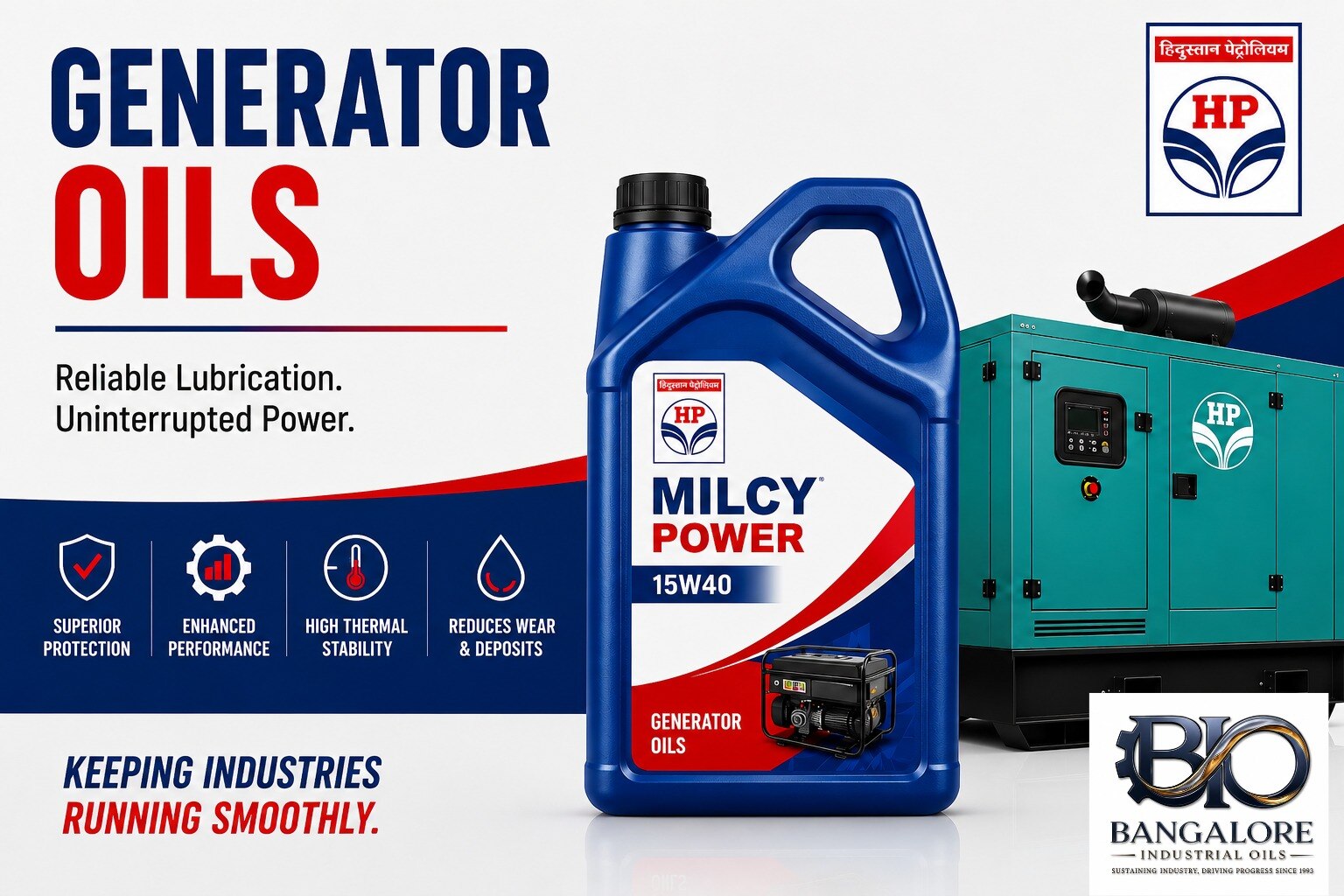
For generator oil distributors HP Milcy Power for comparison in Bengaluru, ask Bangalore Industrial Oils for the product documents and channel evidence, then compare them with competing quotations under identical engine approval and drain-hour assumptions. A 500 kVA rating does not make two engines interchangeable.
Related product
 | GENERATOR OILS Bangalore Industrial Oils is a trusted dealer of MILCY POWER 15W40 Generator Oil, offering premium lubrication solutions designed specifically for... View product → |
Frequently asked questions
What acceptance criteria should you use when comparing generator oils?
Start with the engine manual’s required SAE grade, API service category, named oil specification or approval, sump capacity and permitted drain interval.
Does HP MILCY POWER 15W-40 automatically suit every generator?
No. The 15W-40 label identifies viscosity grade, not approval for every engine. Check the manual’s API category and named specification before use.
How do duty cycle and emissions equipment affect generator oil choice?
Match the oil to engine design, load pattern, operating temperature and emissions hardware. Confirm compatibility with systems such as diesel particulate filters or exhaust gas recirculation when fitted.
How can you compare generator oil distributors in Bengaluru?
Ask suppliers for product documentation, batch traceability, storage and delivery controls, supply continuity evidence and a cost comparison based on oil use, sampling and changeout requirements.