Choosing a straight cutting oil is only the first step: the grade, delivery method, cutting condition, and contamination control determine whether it protects the tool or creates smoke, wear, and poor finish. By the end, you will know how to select, apply, monitor, and procure Trimoffin for different workshop operations in Mysuru.
Key takeaways
- Use neat oil for high-pressure cuts needing boundary lubrication.
- Apply oil directly at the tool-workpiece interface, not across the whole machine.
- Match viscosity and additives to the operation, material, and cutting conditions.
- Filter used oil and isolate it from water, chips, and cleaning chemicals.
When should a workshop use straight cutting oil instead of a water-mix fluid?
Use neat Trimoffin without adding water when the cut needs boundary lubrication and extreme-pressure protection more than rapid heat removal. That makes straight oil appropriate for tapping, threading, broaching, gear cutting, reaming, and some deep-hole drilling, where high contact pressure can tear a tool or spoil a thread.
| Fluid | Main strength | Suitable work | Main limitation |
|---|---|---|---|
| Straight cutting oil | Lubrication and extreme-pressure film | Tapping, threading, broaching, gear cutting, reaming, deep-hole drilling | Less heat removal at high speed |
| Water-miscible fluid | Heat removal and flushing | High-speed turning and milling | May provide less boundary lubrication for severe, slow cuts |
Do not dilute Trimoffin or transfer it into a water-mix system unless the current product technical data sheet expressly permits that use. During high-speed turning or milling, excessive tool temperature, smoke, or loss of dimensional control shows that the oil, delivery rate, or operation may be unsuitable.
Check the recommended viscosity, additive package, tool material, workpiece, speed, and finish before changing fluid. Ask straight cutting fluid suppliers in Mysuru for the exact grade and current technical data sheet, not a generic “cutting oil” substitute. A tapping or broaching grade is not automatically suitable for high-speed machining.
How do you deliver Trimoffin to the tool-workpiece interface?
Start by matching delivery to the cut: put Trimoffin at the tool-workpiece interface, not across the machine enclosure. In metal cutting oil workshops in Mysuru, the right method depends on access, cutting load, and whether the operation needs continuous lubrication or only a controlled film.
| Method | Delivery | Best fit |
|---|---|---|
| Flood through directed nozzle | A pump and nozzle aim oil at the chip-making zone | CNC turning, milling, drilling, and heavy cuts |
| Drip or brush | A measured feed reaches the tool by hand or gravity | Manual tapping, reaming, tool-room work, and low-volume jobs |
| Through-tool | Oil travels through passages in suitable CNC tooling | Deep holes and operations where external spray cannot reach the cutting edge |
| Minimum quantity application | An atomised or metered film limits oil use | Light cuts where a small, stable lubricating film is sufficient |
Keep flow on for the entire cut. Heavy-duty tapping and broaching need a sustained supply because pressure and sliding contact can strip away a surface film; a brush or controlled drip suits occasional manual work when you can place oil directly before and during engagement.
Clear chips between passes and remove them from the work area. Otherwise, excess oil can carry abrasive fines back into the cut. Do not reduce flow until the interface runs dry: rising tool temperature, smoke, chatter, poor finish, or lost dimensional control means the delivery is inadequate.
How should the grade be matched to the operation, material, and cutting conditions?
Choose the grade from the cutting zone, not from the machine name. Compare kinematic viscosity, additive type, sulphur or chlorine content, cutter material, speed, feed, tool geometry, and required surface finish on the current Trimoffin technical data sheet.
| Operation | Material and cutting condition | Grade-selection question |
|---|---|---|
| Turning | Carbon steel or cast iron; continuous cut and moderate-to-high speed | Does the viscosity support heat control, chip removal, and the specified finish without excessive drag? |
| Milling | Carbon steel, stainless steel, or aluminium; interrupted cut | Is the oil suitable for the cutter material, feed, speed, and repeated entry into the work? |
| Drilling | Stainless steel or deep holes; restricted chip evacuation | Does it provide enough lubricity and EP protection without flooding chips into the hole? |
| Tapping | Carbon steel or stainless steel; high pressure and low surface speed | Is a stronger EP package specified? A tapping grade is not automatically suitable for turning. |
| Reaming | Aluminium or steel; tight dimensional and finish limits | Does the viscosity support a clean film without causing oversize holes or drag marks? |
| Broaching | Steel; many teeth under sustained pressure | Is sustained EP protection specified? A broaching grade should not replace a general turning grade. |
| Gear cutting | Steel; precise tooth form and finish | Do the viscosity, additive package, and delivery method suit the cutter and chip load? |
Check aluminium and yellow-metal compatibility separately. Active sulphur can stain or attack copper, brass, and other yellow metals; confirm sulphurised or chlorinated chemistry against the SDS. A search labelled “lubricant spray dealers Aerol” may lead to a maintenance aerosol, not a production cutting grade.
Oil cannot rescue an incorrect speed, feed, blunt tool, or unsuitable geometry.
How do you keep used straight cutting oil clean and safe?
Keep used straight cutting oil clean by starting with a clean, dry system and controlling contamination at every transfer.
- Drain and clean the sump or reservoir before filling. Remove chips, sludge, tramp oil, and old cleaning chemicals, then inspect seals, hoses, pumps, and nozzles for compatibility with Trimoffin.
- Keep water, way lubricant, metal fines, and wash-down chemicals out of the oil. Store it in closed, labelled containers in a dry area, and keep drums and transfer containers sealed between uses.
- Remove solids before returning oil to precision work. Use settling for coarse debris, magnetic separation for ferrous particles, filtration for controlled particle removal, or centrifuging when finer separation is required. Unfiltered sump oil can accelerate tool wear and damage pumps or nozzles.
- Inspect the oil during use for suspended fines, increased viscosity, persistent odour, smoke, or water ingress. Compare it with a retained fresh-oil sample and check viscosity or contamination; do not change the oil on colour alone.
- Treat water ingress as a fault: find the leak, remove the contaminated oil, and correct the source before refilling.
Wear suitable gloves and eye protection, provide ventilation where mist or smoke forms, and read the product SDS for its flash point. Keep welding, flames, hot surfaces, and other ignition sources away from application points. Never use compressed air to disperse oil mist or clean contaminated clothing.
What should you verify before buying Trimoffin for a Mysuru workshop?
Before paying, turn a local enquiry into a documented purchase. A listing for straight cutting fluid suppliers in Mysuru does not prove that the seller holds your required grade.
1. Ask for the exact Trimoffin grade, pack size, batch number, manufacture date, shelf-life information, current product technical data sheet (PDS), and safety data sheet (SDS). Check the label against these documents.
2. Confirm the application and container. Bulk Trimoffin is intended for a machine sump or drip system. An Aerol aerosol may be intended for maintenance, corrosion protection, chain lubrication, or low-volume work; do not assume it has the same viscosity or extreme-pressure package as bulk oil.
3. If you search for lubricant spray dealers Aerol Trimoffin for straight cutting fluid in Mysuru, ask whether the proposed spray is a cutting product or only a maintenance film. A maintenance aerosol can smoke, fail under pressure, or leave unsuitable residue in a production cut.
4. Bangalore Industrial Oils can help a buyer identify the Trimoffin series in Mysuru, but you must confirm stock continuity, formulation, and grade rather than rely on a supplier label alone. Record the approved batch and pack size for repeat orders.
Trial any substitute on a controlled job before production use. Record tool life, surface finish, smoke, filtration behaviour, and cleaning requirements; a cheaper or available oil is not equivalent until those results hold.
Related product
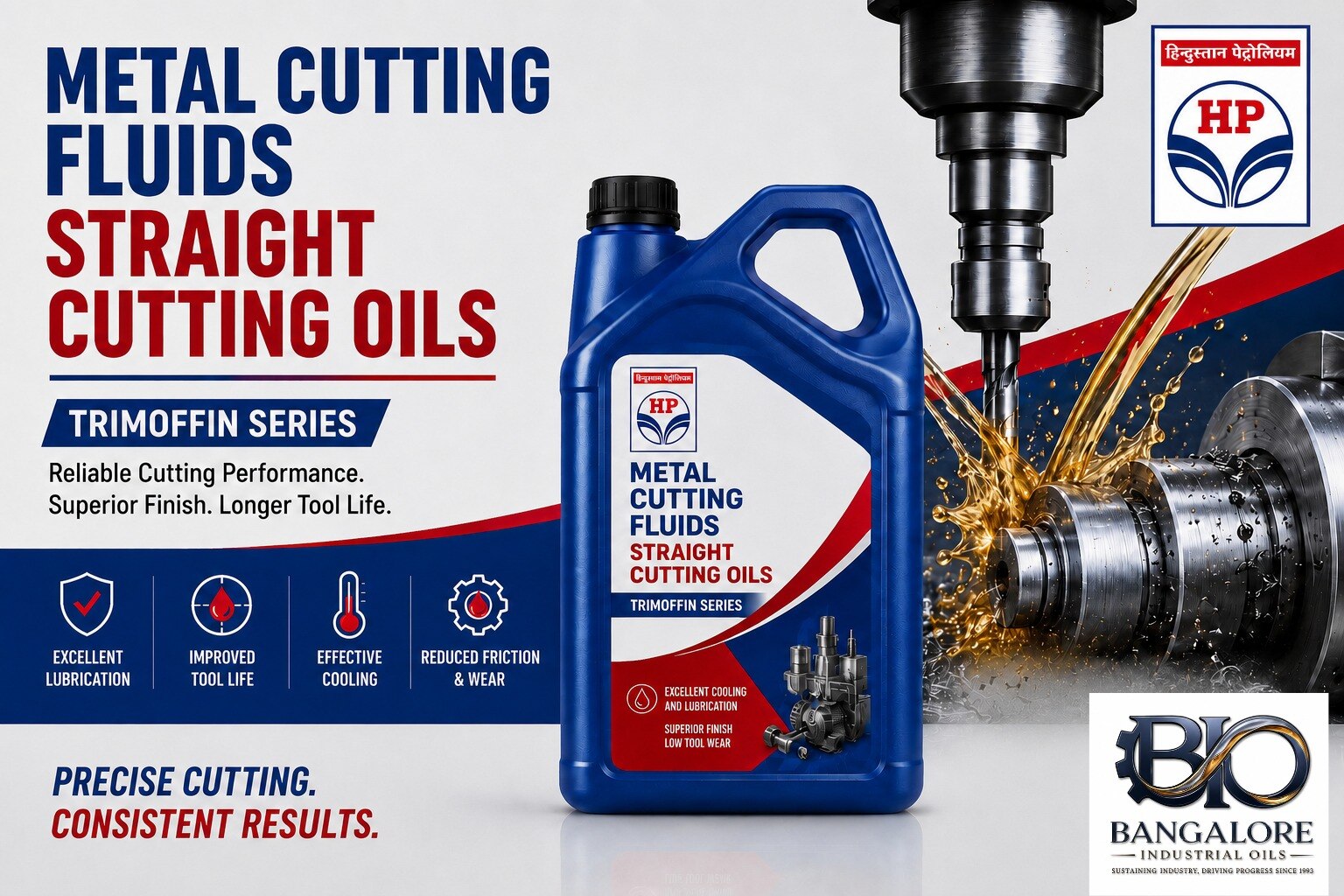
 | METAL CUTTING FLUIDS STRAIGHT CUTTING OILS Searching for reliable Metal Cutting Fluids – Straight Cutting Oils dealers in Karnataka? Bangalore Industrial Oils is a leading supplier offering... View product → |
Frequently asked questions
When should a workshop use straight cutting oil instead of a water-mix fluid?
Use neat Trimoffin when boundary lubrication and extreme-pressure protection matter more than rapid heat removal. It suits tapping, threading, broaching, gear cutting, reaming, and selected deep-hole drilling operations. Use a water-mix fluid when cooling capacity, flushing, or lower fluid consumption is the priority.
How do you deliver Trimoffin to the tool-workpiece interface?
Apply a controlled stream, brush, drip feed, or suitable spray directly where the tool enters the cut. Start flow before engagement, maintain coverage through the cut, and avoid flooding the entire machine when targeted application is sufficient. Confirm spray compatibility with the product SDS and the machine’s ventilation and ignition controls.
How should the grade be matched to the operation, material, and cutting conditions?
Compare the Trimoffin product data sheet with the operation’s pressure, speed, tool material, workpiece alloy, hole depth, and finish requirement. Ask the supplier to identify the recommended viscosity and extreme-pressure package for the specific cut. Do not substitute a heavier grade because it looks more protective; excess viscosity can increase drag, mist, and removal effort.
How do you keep used straight cutting oil clean and safe?
Use a covered, labelled reservoir; remove chips with settling, magnetic separation, or filtration; and prevent water, solvents, hydraulic oil, and cleaners from entering it. Inspect for odour, sludge, colour change, and rising viscosity. Store fresh and used oil away from heat, provide ventilation, and follow the SDS for skin protection, spill response, and disposal.
What should you verify before buying Trimoffin for a Mysuru workshop?
Confirm the exact Trimoffin series and grade, pack size, batch number, manufacture date, seal condition, product data sheet, and safety data sheet. Match the label and documents to your operation, then confirm stock, delivery conditions, and technical support with a straight cutting fluid supplier in Mysuru such as Bangalore Industrial Oils.