Steel hardening depends on more than placing a hot component in an oil tank. You will be able to follow each heat-transfer stage, match the oil grade and bath conditions to the component, and identify the records and tests that show whether the treatment worked.
Key takeaways
- Match the quench oil grade to steel composition, section thickness and production speed.
- Control vapour, agitation, loading and bath temperature to prevent uneven cooling.
- Test viscosity, contamination and cooling performance before approving a used oil bath.
- Ask Mysuru suppliers for the exact Meta Quench grade, batch number and technical data sheet.
From Furnace to Oil Bath: What Happens to the Steel
Steel enters the oil only after it has been heated above its transformation temperature and held until the entire section reaches its austenitising temperature.
The exact workpiece temperature, bath temperature, transfer time and cooling-rate requirement must come from the steel grade, component drawing, heat-treatment procedure and current technical data sheet for the selected Meta Quench grade.
1. Load the carbon or alloy steel into the furnace and heat it uniformly. Hold it long enough for the core, not only the surface, to reach the specified austenitising condition; an oversized section needs more time than a thin one.
2. Transfer the workpiece from furnace to bath within the process recipe’s permitted delay. A long delay lets the surface cool, changes the transformation path and can produce uneven hardness.
Furnace temperature, furnace atmosphere and scale also matter: excessive heat or heavy scale changes surface condition, while geometry affects how quickly oil reaches corners, holes and thick sections.
3. Lower the workpiece into the oil in the specified orientation. Its hot surface immediately creates a vapour blanket, which insulates the steel before the blanket collapses and direct oil contact begins. Agitation and bath temperature control this transition.
4. Remove the part only after the required cooling endpoint, then temper it and inspect hardness, microstructure, dimensions and cracks. Immediate hardness does not prove success. There is no universal temperature or transfer limit for the Meta Quench product family, including oil sourced as industrial heat treatment oil in Mysuru; use the exact grade’s documents.
Vapour, Boiling and Convection: How Quench Oil Controls Cooling
At immersion, a hot workpiece first creates a vapour blanket that insulates its surface and slows heat transfer. As the blanket collapses, nucleate boiling begins; bubbles form and leave the steel, producing the bath’s highest cooling intensity. Convection then controls heat removal as the part approaches bath temperature.
Agitation and bath temperature change the duration and severity of each stage.
The cooling curve must pass through the steel’s hardening range quickly enough to reach martensite-start and form martensite. It must also limit surface-to-core temperature differences, because steep thermal gradients cause cracking, distortion and residual stress.
| Oil type | Cooling behaviour | Practical use |
|---|---|---|
| Plain quenching oil | Controlled conventional cooling | Steels and components suited to moderate, predictable severity |
| Accelerated oil | Greater cooling severity | Components or steels that need faster passage through the hardening range |
| Martempering oil | Hold at a controlled temperature before final cooling | Lowering distortion and residual stress before the final transformation |
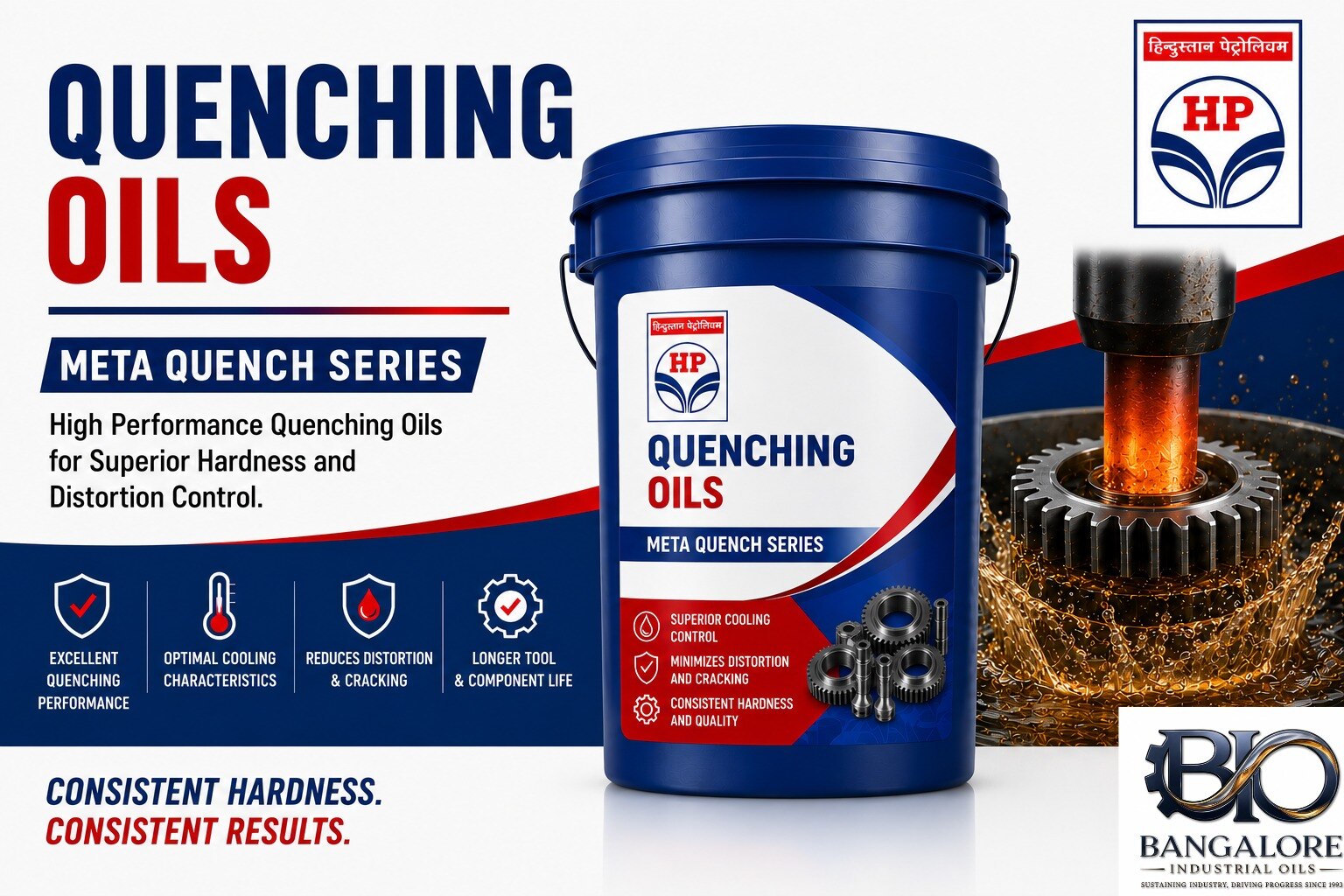
Meta Quench series in Mysuru refers to a product family, not one fixed cooling rate. Before choosing a grade, request its current data sheet and verify the recommended bath temperature, viscosity, flash point and cooling-curve method. Compare results only when the test states the probe, bath temperature, agitation and other conditions.
A hotter bath can reduce viscosity and improve circulation, but it also reduces cooling severity; use the grade’s specified operating band. Never substitute general-purpose machinery oil.
Choosing the Grade for Steel, Section Size and Production Output
Select the oil against hardenability, section thickness, target hardness, case depth and allowable distortion—not the Meta Quench family name. Meta Quench is a product family, so the exact grade’s data sheet must define cooling severity, bath temperature and operating limits.
| Component | Selection priority | Main risk |
|---|---|---|
| Carbon-steel shaft or forging | Higher severity for thick, low-hardenability sections; verify core hardness | A slow oil leaves a soft core |
| Alloy-steel gear or bearing | Match moderate severity to thin section, target hardness and case depth | Excessive cooling cracks teeth or distorts races |
| Die or heavy forging | Control thermal gradients and distortion across the section | A severe oil can warp the tool before hardness is uniform |
A thick low-hardenability forging may need faster cooling than a thin alloy-steel gear. The reverse choice can harden one component successfully while cracking or warping another.
Size the bath for furnace output, load mass, basket capacity and cycle time. If production exceeds the bath’s heat-rejection capacity, each load raises oil temperature, reduces cooling severity and creates weaker cooling around tightly packed parts. Specify load arrangement, agitation and the permitted furnace-to-bath delay.
Compare suppliers with a standardised cooling curve, not viscosity or flash point alone. ASTM D6200 and ISO 9950 results must identify the probe, bath temperature, agitation and test conditions.
A quenching oil is not interchangeable with general-purpose machinery oil. The latter is a lubricant, not an approved controlled-cooling medium; a search for general purpose machinery oil wholesalers hp does not establish quench suitability.
Controlling the Tank: Agitation, Loading and Bath Condition
Uniform cooling starts with directed oil flow, not simply a running pump. Set pump direction and flow so oil reaches every face of the load, eliminating dead zones at tank walls, corners and the basket base. Space and orient parts so oil can replace trapped vapour; tightly nested gears, shafts and forgings cool unevenly.
The process recipe must state agitation condition, load mass and arrangement. Excessive agitation can increase distortion, shift parts in fixtures and produce uneven hardness.
Use this bath-control checklist:
- Check bath temperature and level before each load; a heavy basket can raise temperature and reduce local cooling.
- Trend viscosity, water, sludge, flash point, acid number, oxidation products and cooling-curve performance against the plant baseline. Use a standard probe or quenchometer when the quality system requires it.
- Investigate water from wet baskets, condensation, water-based cleaners, heat-exchanger leaks and damp components. Water causes foaming, erratic cooling, corrosion, violent ejection and fire.
- Keep tanks covered, provide exhaust or vapour control, and test temperature interlocks. Use a water-free fire response; never put water into burning hot oil.
- Treat dark colour as a warning, not proof of failure. Varnish, deposits, smoke, rising viscosity or changed cooling behaviour require testing.
- Confirm any top-up oil is approved for the bath. An unapproved oil can change the cooling curve even when its colour looks identical.
When comparing quenching oil suppliers in Mysuru, request documented cooling-curve results with the probe, bath temperature, agitation and test conditions identified.
Proving the Result and Buying the Correct Grade in Mysuru
A failed batch does not prove that the quench oil caused the defect. Prove the result after tempering, then separate oil behaviour from furnace, material, handling and fixture errors.
1. Map hardness after tempering at the surface, core and defined intervals across the component. Examine case depth or microstructure, check dimensions and distortion, inspect for cracks, and compare every result with the component drawing.
2. Review a failed batch against austenitising temperature, soak time, transfer delay, steel composition, agitation, loading pattern and fixture design. An incorrect soak or a trapped vapour pocket can produce soft areas that look like an oil failure.
3. Check the purchase before approving replacement oil. Buyers searching for meta quench series in Mysuru or quenching oil suppliers in Mysuru should request the exact grade, current technical data sheet, safety data sheet, batch certificate, operating-temperature band, cooling-curve data or test method, packing and shelf-life details, and technical support.
4. For searches involving general purpose machinery oil wholesalers hp meta quench in mysuru, confirm that the quotation names approved quenching oil, not general-purpose machinery oil. Machinery oil lubricates; it does not provide validated quench cooling.
Bangalore Industrial Oils, a local HP-authorised clearing and forwarding distributor, can help identify the quoted grade and documentation, but availability alone does not prove process suitability. Compare cooling data from the stated test method, not a supplier’s viscosity or flash-point figure alone.
Frequently asked questions
What happens to steel when it moves from the furnace into Meta Quench oil?
After austenitising, the steel enters the oil bath. Rapid heat removal transforms the austenite into harder structures, while the cooling rate affects hardness, distortion and cracking risk.
How do vapour, boiling and convection affect quenching?
The oil first forms a vapour blanket around the hot steel, then boils at the surface before convection removes heat. Agitation breaks up the vapour blanket and improves cooling uniformity.
How do you choose the correct Meta Quench grade?
Compare the oil grade with the steel type, part thickness, required hardness, furnace temperature and production output. Use the supplier’s technical data sheet rather than choosing by product name alone.
How do you control and verify a quench oil tank?
Control bath temperature, agitation speed, loading pattern and oil level. Check viscosity, water contamination, sludge, flash point and cooling performance, then record hardness and distortion results on treated parts.