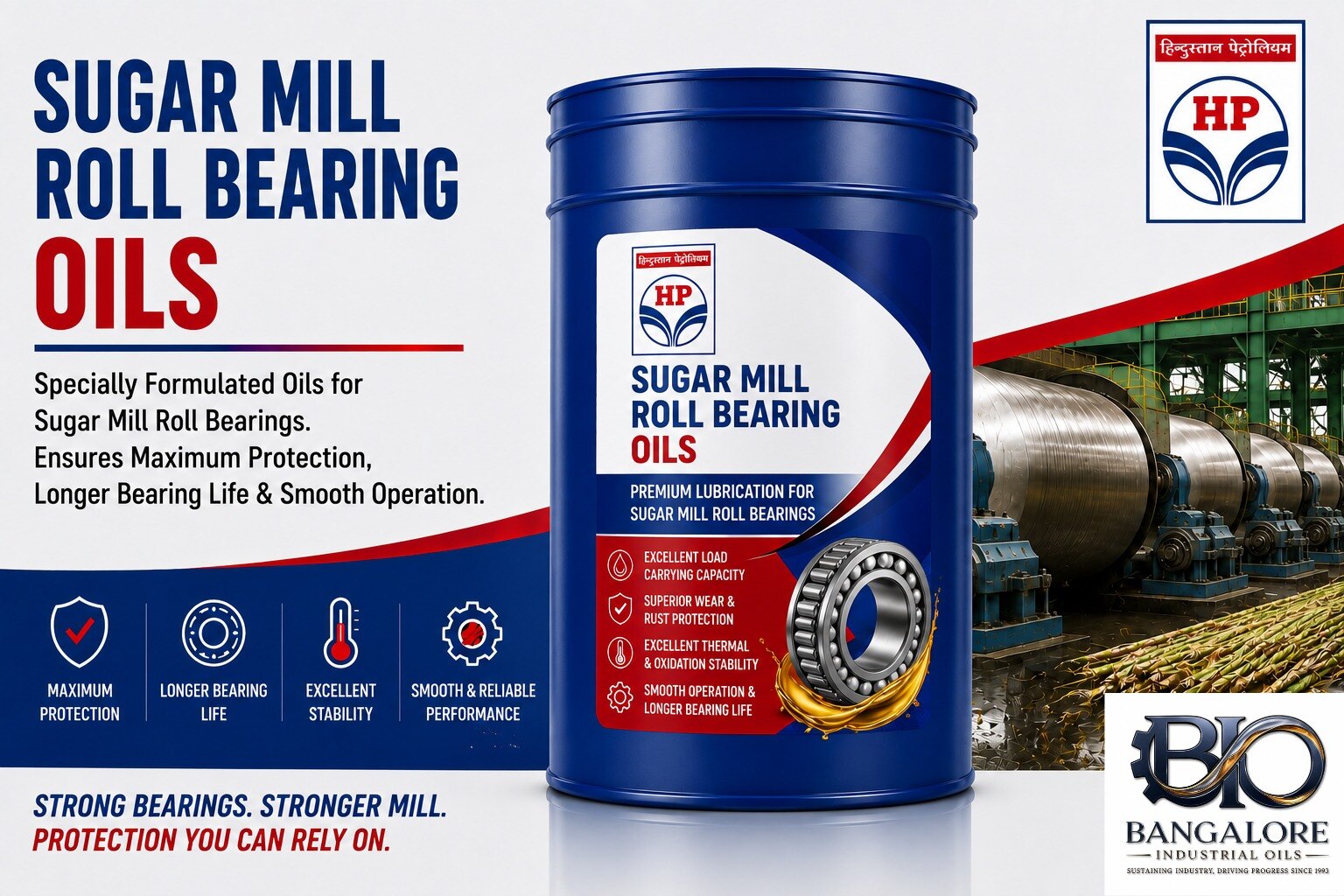
HP Crushwell 2, 3 and 4 are separate industrial oil grades for sugar-mill roll or roll-neck bearings, not three versions of car engine oil or NLGI grease. By the end, you will know how to confirm the grade, match it to the bearing and lubrication system, manage contamination, and verify a Mysuru purchase before it reaches the mill.
Key takeaways
- Crushwell 2, 3 and 4 identify oil viscosity grades, not grease consistencies.
- Match the grade to bearing load, temperature and the manufacturer’s lubrication instructions.
- Drain contamination and inspect seals when water, juice or mill debris enters the bearing.
- Verify the batch number, sealed packaging and authorised supply channel before buying.
What the Crushwell 2, 3 and 4 numbers actually identify
The numbers identify oil viscosity grades, not grease consistency or separate application variants. HP Crushwell 2, 3 and 4 are industrial lubricating oils for sugar-mill roll or roll-neck bearing service.
The commonly associated mapping is:
- Crushwell 2: approximately ISO VG 220
- Crushwell 3: approximately ISO VG 320
- Crushwell 4: approximately ISO VG 460
Treat those values as a buying guide, not a specification. Before ordering, read the current HP technical data sheet and confirm the exact viscosity at 40°C, permitted tolerance, base-oil description, additive chemistry, water-separation behaviour, oxidation resistance, load-carrying results and operating-temperature limits.
These numbers are not NLGI 2, NLGI 3 or NLGI 4 grease grades. SAE engine-oil viscosity and an API category do not define suitability for a slow, heavily loaded mill roll bearing exposed to water, juice and solids.
The search phrase car engine oil dealers hp crushwell sugar mill roll bearing oil in mysuru is potentially misleading because a listing for HP car oil does not prove that the seller holds the correct industrial Crushwell grade. Confirm the product name and grade on the sealed container and technical data sheet.
Do not assume food-contact or sugar-contact approval. Obtain a specific food-contact approval when the lubrication point could expose oil to sugar or process material; industrial bearing service alone does not provide that approval.
How to select a grade and apply it to the roll bearing
Do not choose by number alone: match the oil to the bearing, load, temperature and lubrication system. Before selecting an ISO VG 220, 320 or 460 equivalent, collect:
- Bearing type, journal diameter, radial clearance, load and speed
- Bearing lining, roll design, ambient temperature and oil temperature
- Leakage history and the bearing manufacturer’s recommendation
Crushwell 2, 3 and 4 are not interchangeable. The usual comparison is:
| Grade | Approximate viscosity equivalent | Selection tendency |
|---|---|---|
| Crushwell 2 | ISO VG 220 | Easier startup, pumping and circulation |
| Crushwell 3 | ISO VG 320 | Intermediate film strength and flow resistance |
| Crushwell 4 | ISO VG 460 | Higher film strength and leakage control |
A higher viscosity can protect the oil film when load and temperature permit; a lower viscosity suits demanding startup, low-temperature flow or restricted circulation. Confirm whether the bearing is a journal, bronze-lined, babbitt-lined or another arrangement, then verify whether oil enters through an oil bath, calibrated drip feed, circulating pump, forced-feed system or once-through supply.
Set the oil-bath level to the bearing maker’s mark, calibrate drip feed to its specified requirement, and verify circulation flow, reservoir capacity, return-line fall and design, filtration, drain points and temperature monitoring. Do not invent a universal feed rate.
The bearing maker or current HP data sheet must settle the final grade for sugar mill bearing oil in Mysuru.
How water, juice and mill debris change oil maintenance
Sugarcane juice, wash water, humidity and bagasse dust turn roll-bearing oil into a contamination-control problem. Water promotes sludge, rust and additive depletion; dissolved sugar leaves sticky deposits, while bagasse loads filters and accelerates abrasive wear. Oil life falls faster when the reservoir breathes damp air or wash water enters through seals.
Inspect the oil and bearing at each defined check:
- Dark colour, sour odour, milkiness, free water or sludge indicates contamination or oxidation.
- Bright metal or babbitt particles require an immediate engineering investigation.
- Low reservoir level or a blocked feed suggests oil starvation.
- Milky oil or free water confirms water contamination until testing proves otherwise.
- Persistent leakage with correct feed suggests excessive clearance or sealing trouble.
- Uneven temperature and vibration suggest misalignment or mechanical damage.
- Record bearing temperature and its rise from the normal baseline; inspect the filter, reservoir level, leakage points and drain water.
Sample after wash-down ingress, juice leakage, filter blockage or an overheating event, and at a defined routine frequency. Test viscosity, water content, particle count, TAN and wear metals before deciding to drain or continue the charge. A fixed calendar change alone misses contamination between changes and wastes oil that remains fit for service.
Control top-ups by confirming the exact Crushwell grade, clean transfer equipment and a dry sealed container. Sugar mill roll bearing oil distributors should provide traceable product; never add oil simply because its label says industrial lubricant. Restore the specified level, investigate recurring loss, and keep samples and filter findings with the bearing record.
How to change over from grease, gear oil or another lubricant
Do not top up with Crushwell until you identify the lubricant already in the bearing. Record its product name, base oil, additive system, seal material, hose material, bearing lining and automatic lubrication equipment; a search result labelled “car engine oil dealers hp” does not establish compatibility or suitability.
- Obtain compatibility confirmation before mixing mineral oils or compounded oils. Similar appearance does not prove compatible chemistry.
- Drain the old charge and clean the reservoir, bearing housing and lines. Inspect filters and remove sludge or separated oil.
- Flush with an approved compatible oil when the change involves grease, a substantially different lubricant or an uncertain formulation.
- Refill Crushwell to the specified level, restore the correct feed setting and document the product, grade, batch, date and quantity.
Bearing grease belongs in a grease-designed system. Circulating oil belongs where the pump, reservoir and return path are designed for circulation; forcing it through a grease system can cause leakage or starvation. Gear oil is intended for gear contacts, not a roll bearing, unless the equipment maker specifies it.
General-purpose hydraulic oil and passenger-car engine oil lack the required service specification for this application.
A wrong grade or poor changeover can cause overheating, leakage, reduced film strength, lining wear, stoppage and premature bearing replacement. If the current lubricant, lining or equipment design cannot be verified, stop the change and obtain the bearing maker’s or lubricant supplier’s written recommendation.
What to verify before buying Crushwell 2, 3 or 4 in Mysuru
A purchase for sugar mill bearing oil in mysuru becomes verifiable only when the enquiry names the grade, pack size, quantity, delivery point and required batch age. Treat “crushwell 2 3 4 in mysuru” as three separate stock enquiries, not one blended product.
- Request the current technical data sheet and safety data sheet for the exact grade: Crushwell 2, Crushwell 3 or Crushwell 4.
- Ask for the batch number, manufacturing date, certificate of analysis when required, sealed-pack confirmation and the permitted batch-age requirement.
- Verify an HP-authorised distribution relationship specifically for CRUSHWELL 2/3/4. Do not infer it from a listing under “car engine oil dealers hp”; automotive listings do not prove industrial Crushwell stock.
- Obtain separate confirmation for each grade, including available pack sizes, minimum order quantity, available batch dates, Mysuru delivery method and lead time.
Before accepting delivery from sugar mill roll bearing oil distributors, inspect each container:
- Intact seal and legible product label
- Clean exterior, with no dents, leaks or water exposure
- Indoor storage on dry bunding
- Capped transfer equipment
- First-in-first-out stock rotation
Bangalore Industrial Oils is a Mysuru industrial-oil source only after it confirms the requested grade, documents, source and delivery terms. Do not approve an order until those details identify whether you are receiving Crushwell 2, Crushwell 3 or Crushwell 4.
Related product
 | SUGAR MILL ROLL BEARING OILS CRUSHWELL - 2/3/4 Bangalore Industrial Oils is a trusted dealer of CRUSHWELL 2/3/4 Sugar Mill Roll Bearing Oils, offering premium lubrication solutions for heavy-duty... |
Frequently asked questions
What do the Crushwell 2, 3 and 4 numbers identify?
They identify oil viscosity grades for industrial lubrication; they are not grease consistency grades or separate application variants.
How do you select a Crushwell grade for a sugar mill roll bearing?
Match the grade to the bearing manufacturer’s instructions, operating temperature, load, speed and the oil-feed system. Do not choose by number alone.
How do water, juice and mill debris affect roll bearing oil maintenance?
They reduce lubricant performance and accelerate wear. Inspect seals, remove contaminated oil, clean the housing and correct the contamination entry point.
What should you verify before buying Crushwell 2, 3 or 4 in Mysuru?
Check the exact grade, sealed pack, batch number, manufacturing details, product documentation and the distributor’s authorised supply credentials.