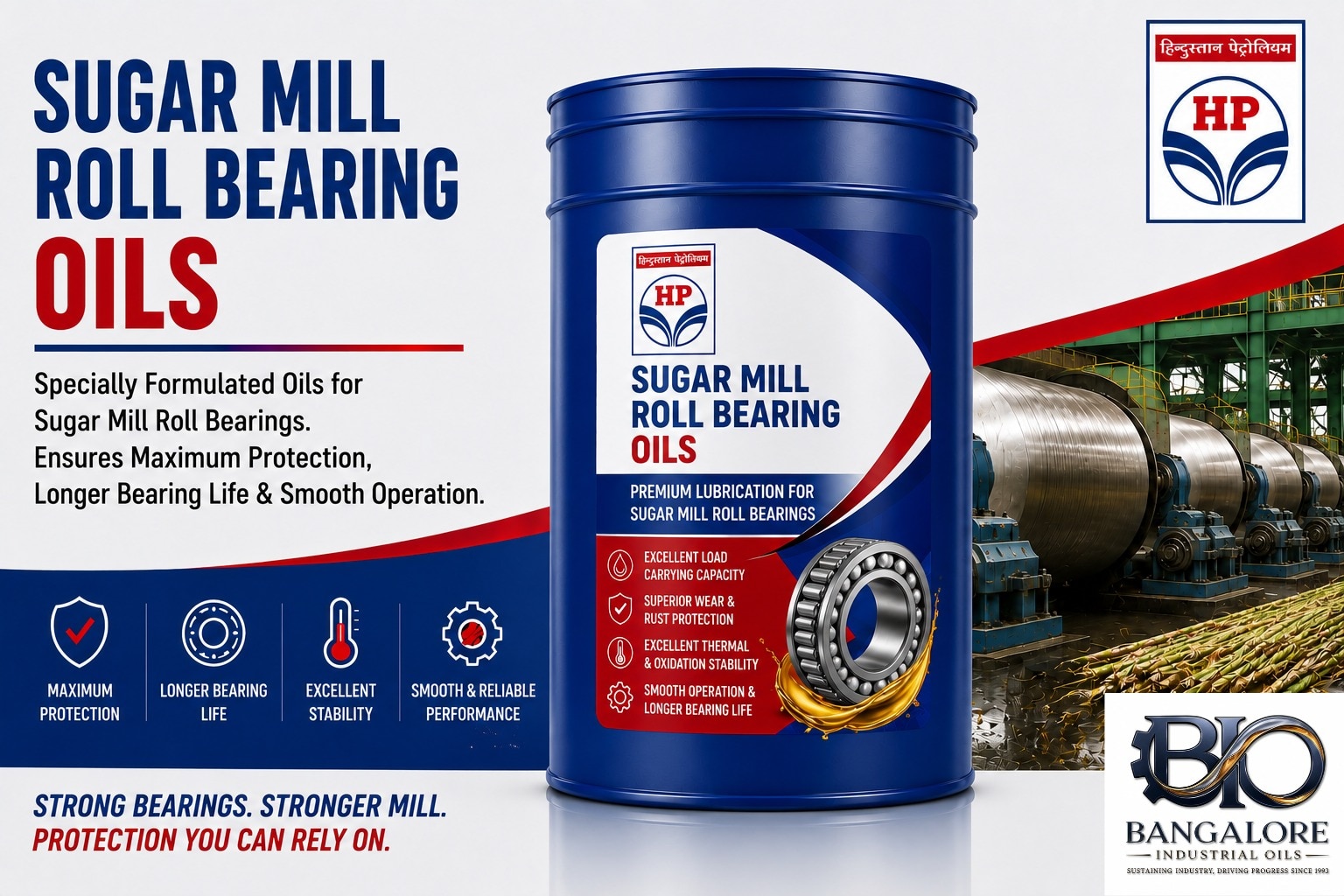
Choosing between Crushwell 2, Crushwell 3, and Crushwell 4 requires more than matching a grade number to a roll bearing. You will be able to compare the current technical data, match the oil to your bearing and feed system, manage contamination and changeover, and verify whether a Bengaluru supply is technically and commercially fit for your mill.
Key takeaways
- Compare Crushwell grades using current technical data sheets, not grade numbers.
- Match oil to bearing design, load, temperature, speed, and delivery method.
- Control water, cane juice, sugar dust, and wear debris before they damage bearings.
- Verify the Bengaluru supplier’s HP authorisation, batch records, and repeat-supply process.
Compare Crushwell 2, 3, and 4 by verified data—not grade number
The numbers in Crushwell 2, Crushwell 3, and Crushwell 4 are product-grade designations, not ISO VG 2, 3, and 4. A reliable crushwell 2 3 4 comparison therefore starts with the current technical data sheet, not the grade number or a supplier’s verbal description.
| Product | Verify in the current TDS | What the difference could mean |
|---|---|---|
| Crushwell 2 | Kinematic viscosity at 40 °C and 100 °C, viscosity index, flash point, pour point | Lower or higher film thickness, starting resistance, and temperature margin; do not assume its load range |
| Crushwell 3 | The same viscosity and temperature data, plus roll-bearing application | Confirm the manufacturer’s stated bearing, load, speed, and operating-temperature limits |
| Crushwell 4 | The same data, plus water separation, rust protection, oxidation stability, and wear-test results | A thicker oil is not automatically better for a heavily loaded or hotter roll bearing |
Require the viscosity test method, preferably ASTM D445, because a value without test temperature and method cannot support a technical comparison. Also ask whether each grade is mineral, compounded, or another formulation, and identify additives that could affect seals, bronze, white metal, or other bearing materials.
Before approval, compare the stated application with the bearing manual and inspect the oil condition. Free water, milky oil, sludge, or rapid rusting points to ingress or drainage failure; selecting a heavier grade will not correct that.
Do not top up across grades until compatibility is confirmed; drain contaminated oil, inspect the housing, and flush when the change requires it.
Match the grade to bearing design, load, temperature, and speed
Begin with the roll-bearing manufacturer’s manual, not Bengaluru’s ambient temperature. Select the Crushwell grade whose stated viscosity fits the bearing at its actual operating temperature, then check whether its load, speed, and feed requirements match the mill’s conditions.
- Confirm the bearing design: spherical roller, cylindrical roller, plain bush, or another arrangement. Note the clearance, oil-bath or circulation system, housing volume, seal design, and the manual’s specified ISO viscosity grade or kinematic viscosity.
- Measure bearing temperature after the mill reaches steady production. Compare that temperature with the manual’s operating range and the Crushwell technical data sheet; a grade that works at startup can become too thin at running temperature.
- Record roll load, shaft speed, shock loading, and oil-feed rate. Heavy load demands an adequate lubricating film, while excessive viscosity at high speed increases churning, heat, and power loss.
- Check the grade against the oil system. An oil-bath bearing needs suitable flow and level behaviour; a circulation system also needs filtration, return-flow performance, and pump compatibility.
- Reject any grade that falls outside the manual’s viscosity or temperature limits, even if its grade number sounds heavier.
Do not assume Crushwell 4 suits every high-load bearing or that Crushwell 2 suits every fast roll. Use the current TDS for viscosity, viscosity index, flash point, pour point, water separation, and rust protection, and obtain the manufacturer’s approval before cross-using sugar mill roll bearing oil in a gearbox, hydraulic unit, or another bearing design.
Set up oil-bath, drip-feed, splash, and circulation systems correctly
Do not fill a roll-bearing housing to the cover. Use the manufacturer’s level mark; excess oil churns, heats, and leaks, while too little oil leaves the loaded zone dry. Select Crushwell oil only after confirming the bearing manual’s viscosity and temperature limits.
| System | Fill | Filter and flush | Replace |
|---|---|---|---|
| Oil bath | Fill with clean oil to the marked level while the shaft is stationary. | Drain the old charge, clean the sump and magnetic plug, and flush with compatible oil before refilling. | Check level each shift; replace after the mill’s oil-life interval or after water, sludge, or metal appears. |
| Drip-feed | Fill the reservoir with the specified grade and prime the line. Set the drip rate from the bearing maker’s instruction, not by visual leakage. | Clean the strainer, flush the line until flow is clear, and confirm oil reaches the bearing. | Refill before the reservoir runs low; change the charge when inspection finds contamination or viscosity change. |
| Splash | Fill the gearbox-like reservoir only to its level mark; confirm the rotating ring or collar enters the oil correctly. | Drain warm oil, wash out settled sludge, clean screens, and flush before charging. | Replace at the documented interval and after a failed water or wear inspection. |
| Circulation | Fill the tank, open the return path, and run the pump at low speed to remove air before checking level. | Use the specified filter, change it at its restriction indication, and circulate flushing oil through every line before restart. | Replace tank oil after laboratory or inspection limits are reached. |
Never assume oil approved for a nearby gearbox or hydraulic system suits the bearing. For sugar mill bearing oil in Bengaluru, record the grade, batch, fill date, and filter change.
Control water, cane juice, sugar dust, and wear contamination
A clean-looking sugar mill roll bearing oil does not prove that the bearing is clean. Water can settle below the sight glass, while sugar, cane fibre, and wear metal remain suspended or stick to housing surfaces. Draw a sample from the lowest drain after the bearing has rested, using a clean, dry bottle.
Label it with the bearing ID and sampling time.
Look for these contamination signatures:
- Water: a separate bottom layer, cloudy emulsion, rust, or a positive crackle test. Confirm suspected water with a laboratory Karl Fischer result, and request the oil’s demulsibility result. Water resistance does not prove rapid water separation.
- Cane juice or wash-down fluid: sticky deposits, dark residue, rising acidity, or an emulsion after cleaning. Compare viscosity and water content with unused oil.
- Sugar dust and fibre: gritty sediment, blocked breathers, or deposits at seals and drains. Inspect the housing, labyrinth, and drain path.
- Wear metal: grey particles, abnormal filter debris, rising vibration, or higher bearing temperature. Use a magnet for ferrous debris and send non-ferrous particles for microscopy or elemental analysis.
Set action limits before the crushing season. Record sample condition, bearing temperature, vibration, and operating hours so deterioration becomes a trend rather than a guess. If water forms a layer or debris is heavy, stop topping up.
Find the failed seal or blocked drain, drain the oil, inspect the bearing, and flush only with a confirmed-compatible grade before refilling.
Verify the Bengaluru supplier, batch, and repeat-supply controls
A product listing is not proof of supply. Treat searches for sugar mill roll bearing oil distributors HP as lead generation, then obtain written confirmation that the exact Crushwell grade and pack size are physically available in Bengaluru.
1. Ask for the exact product name and grade, pack size, quantity in stock, dispatch location, batch number, manufacture date, and planned dispatch date. Match each detail with your purchase order.
2. Request the current TDS and SDS, the viscosity test method, demulsibility or water-separation result, and a certificate of conformity or batch certificate when your quality system requires one. Tacky or water-resistant oil is not automatically demulsifying oil.
3. Inspect delivery before acceptance. Check intact seals, legible batch identification, correct grade and pack size, and the absence of sediment or free water. Reject or quarantine stock with an unverifiable age, damaged packaging, or storage evidence showing rain, direct sun, or open contamination.
4. Confirm repeat-supply controls in writing: replenishment lead time, minimum order quantity, available pack sizes, and notification before a batch or formulation changes. A distributor may have sugar mill bearing oil in bengaluru today but fail to support the next shutdown.
Bangalore Industrial Oils should be assessed against these same records, not against catalogue presence alone. Keep Crushwell oil assigned to the approved roll-bearing application; using it in a gearbox or hydraulic system requires a separate viscosity, seal, additive-compatibility, and equipment-manufacturer check.
Related product
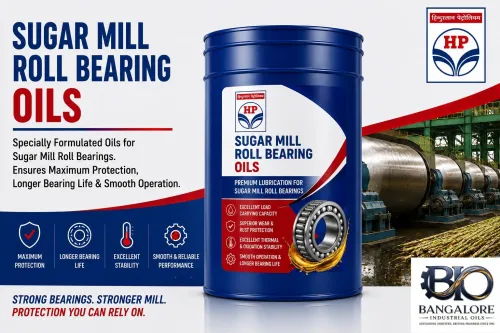
 | SUGAR MILL ROLL BEARING OILS CRUSHWELL - 2/3/4 Bangalore Industrial Oils is a trusted dealer of CRUSHWELL 2/3/4 Sugar Mill Roll Bearing Oils, offering premium lubrication solutions for heavy-duty... |
Frequently asked questions
Are Crushwell 2, 3, and 4 the same as ISO VG 2, 3, and 4?
No. The Crushwell numbers are product-grade designations. Compare their current technical data sheets instead of treating them as ISO viscosity grades.
How do you choose between Crushwell 2, 3, and 4 for a sugar mill roll bearing?
Check the bearing design, load, operating temperature, shaft speed, sealing arrangement, and lubrication method against the verified technical data for each grade.
How should sugar mill roll-bearing oil systems be set up?
Configure oil-bath, drip-feed, splash, or circulation systems to maintain the specified oil level and flow, while preventing leaks and contamination.
What contamination controls matter in sugar mill roll bearings?
Inspect and control water, cane juice, sugar dust, and wear debris through sound seals, clean handling, leak checks, filtration where specified, and oil inspections.
What should you verify with a Bengaluru sugar mill bearing oil distributor?
Request the current technical data sheet, product batch details, authenticity records, HP authorisation evidence where claimed, and a documented repeat-supply process.